
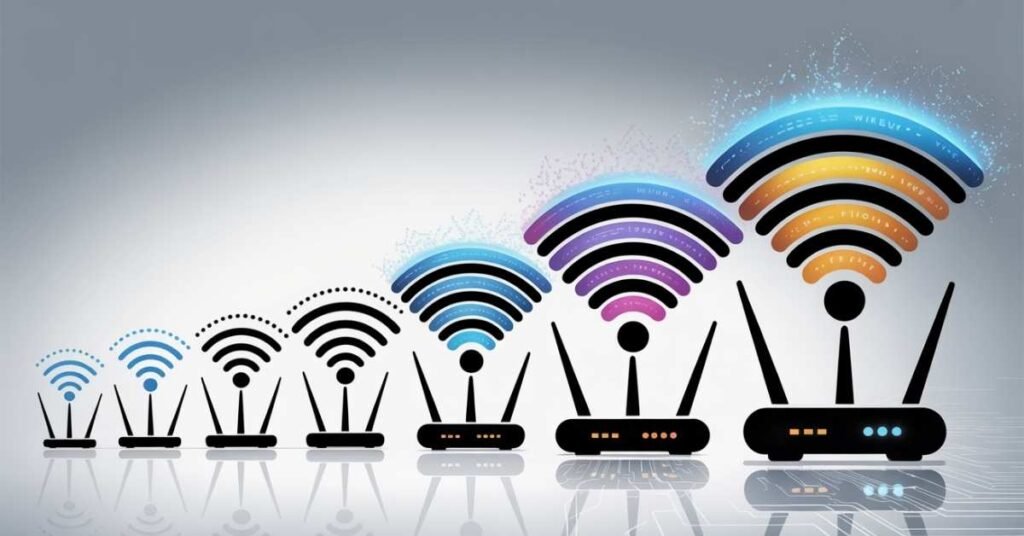
Wi‑Fi’s Hidden Power Curve represents three decades of invisible innovation that transformed American connectivity. Most people upgrade routers without understanding the quantum leaps happening beneath the surface. From 1999’s humble 11 Mbps to today’s multi-gigabit speeds, each generation solved problems you didn’t know existed.
This journey matters because your stable network depends on understanding wireless evolution. Remote work, streaming, and smart homes all ride on this wireless signal revolution. The breakthroughs coming with Wi-Fi 8 will redefine what reliable home Wi-Fi actually means for millions of users nationwide.
The Evolution Behind Wi-Fi’s Hidden Power Curve: From Wi-Fi 1 to Wi-Fi 8

Wi‑Fi’s Hidden Power Curve began in 1999 when Wi-Fi 1 liberated internet access from Ethernet cables. The 802.11b standard delivered just 11 Mbps—barely enough for email and basic browsing. Coffee shops became testing grounds for this revolutionary wireless internet technology that changed everything.
Wi-Fi 2 followed shortly thereafter, marking the next step in Wi-Fi’s Hidden Power Curve with speeds reaching up to 54 Mbps on the 5 GHz band. The faster frequency band produced better performance, showcasing the steady evolution of Wi-Fi’s Hidden Power Curve. Each upgrade refined signal efficiency and user experience, proving how Wi-Fi’s Hidden Power Curve kept pushing wireless innovation forward.
In 2003, the rollout of Wi-Fi 3 (802.11g) showcased Wi‑Fi’s Hidden Power Curve, providing the very best of both worlds. It limited speed to a maximum of 54 Mbps while staying in the more user-friendly 2.4 GHz band, which could penetrate walls better than the 5 GHz band. This generation marked a key step in Wi‑Fi’s Hidden Power Curve, making wireless deployment practical for homes and small businesses around the United States. Early adopters could now experience the real benefits of Wi‑Fi’s Hidden Power Curve in everyday connectivity.
Key early milestones
- Wi-Fi 1: 11 Mbps speeds, 2.4 GHz frequency (1999).
- Wi-Fi 2: 54 Mbps speeds, 5 GHz frequency (1999).
- Wi-Fi 3: 54 Mbps speeds, upgraded 2.4 GHz (2003).
- Wi-Fi 4: 600 Mbps speeds, MIMO technology (2009).
Launched in 2009, Wi-Fi 4 (802.11n) was a monumental leap forward in wireless technology by using advanced multiple antenna technology. MIMO technology bumped the stated wireless speeds to 600 Mbps and finally provided reliable home networks. Households could now have more than one device on their network without experiencing a bottleneck—an essential enhancement given the exponential growth of devices per household each year.
The quality of wireless signals improved tremendously with the beamforming feature embedded in Wi-Fi 4, a major leap in Wi-Fi’s Hidden Power Curve. Instead of broadcasting signals like floodlights, routers could now target them like spotlights toward devices—enhancing the precision of Wi-Fi’s Hidden Power Curve. This advancement improved signal strength and Wi-Fi coverage in countless homes across America, further proving the power of Wi-Fi’s Hidden Power Curve.
Wi-Fi 5 came about in 2014, delivering real-world performance of 1.3 Gbps that finally made it competitive with Ethernet speeds. MU-MIMO technology concurrently served multiple devices—this was increasingly critical as households added additional devices. Common usage was accelerated into more households after the introduction of services like Netflix and YouTube, and the powerful new standard was adopted nationwide.
Mid-generation breakthroughs
- MIMO technology multiplied antenna effectiveness.
- Beamforming directs signals precisely to devices.
- MU-MIMO served multiple devices simultaneously.
- Gigabit speeds became a reality for consumers.
READ ALSO: Google Gemini 3 Pro & Nano Banana 2: Powerful Leaks That Will Redefine AI Creativity
How Each Wi-Fi Generation Redefined Speed, Range, and Connectivity in the U.S.

Wi‑Fi’s Hidden Power Curve accelerated dramatically with Wi-Fi 6 in 2019, built for device density. This standard handled 50+ gadgets per household efficiently using OFDMA technology that divided channels. OFDMA served more devices by splitting the bandwidth into smaller, manageable chunks for better performance.
Wi-Fi 6E unlocked America’s 6 GHz spectrum in 2020, adding 1.2 GHz of pristine bandwidth—a major milestone in Wi‑Fi’s Hidden Power Curve. This new frequency band eliminated interference from legacy devices cluttering older bands, further advancing Wi‑Fi’s Hidden Power Curve. The optimal signal quality in 6 GHz makes it perfect for demanding applications like 4K streaming, showcasing another leap in Wi‑Fi’s Hidden Power Curve.
Target Wake Time (TWT) revolutionized IoT device battery life significantly in Wi-Fi 6. Smart sensors could sleep longer between transmissions, extending battery life from months to years. This feature made the network implementation of massive sensor networks practical for smart homes.
Speed progression across Wi-Fi generations
| Wi-Fi Generation | Standard | Max Speed | Real-World Speed |
|---|---|---|---|
| Wi-Fi 1 | 802.11b | 11 Mbps | 5 Mbps |
| Wi-Fi 4 | 802.11n | 600 Mbps | 200 Mbps |
| Wi-Fi 5 | 802.11ac | 3.5 Gbps | 1.3 Gbps |
| Wi-Fi 6 | 802.11ax | 9.6 Gbps | 3 Gbps |
| Wi-Fi 7 | 802.11be | 46 Gbps | 15 Gbps |
| Wi-Fi 8 | 802.11bn | 100+ Gbps | 30+ Gbps |
Wi-Fi 7 launched in 2024, delivering 46 Gbps theoretical speeds with 320 MHz channels, marking a major milestone in Wi‑Fi’s Hidden Power Curve. Multi-Link Operation (MLO) connects devices across multiple bands simultaneously for redundancy, demonstrating another leap in Wi‑Fi’s Hidden Power Curve. This innovation eliminates frustrating dead spots and connection drops that plagued earlier generations, showcasing the ongoing evolution of Wi‑Fi’s Hidden Power Curve.
The dBm level requirements changed as technology improved over the years. Modern routers maintain consistent Wi-Fi even at lower signal strengths than before. Better modulation schemes extract more data from weaker signals than older generations could manage.
Signal quality metrics evolved alongside speed improvements throughout Wi-Fi’s history. RSSI (Received Signal Strength Indicator) readings became more sophisticated with each generation. Today’s devices perform signal assessment continuously, switching channels before problems occur automatically.
Wi-Fi 8’s Revolutionary Leap — What Makes It the Fastest and Smartest Yet
Wi‑Fi’s Hidden Power Curve reaches new heights with Wi-Fi 8 (802.11bn) expected between 2028-2030. This standard targets 100 Gbps theoretical speeds with ultra-high reliability as its foundation. Intelligence becomes built into the fabric of the network itself through advanced algorithms.
Coordinated spatial reuse allows multiple access points to share spectrum without interference challenges. Networks operate together as a group rather than individually competing for airspace like generations before us. This collaborative effort increases the performance range density of network usage across entire attributes, like apartment buildings, throughout the country.
Integrating machine learning results in self-optimizing networks that learn household usage patterns over time. Your home network anticipates bandwidth needs before spikes occur during peak usage times. Predictive channel switching transitions devices away from interference before we see problems arise.
Revolutionary Wi-Fi 8 features
- Theoretical throughput capability of 100+ Gbps.
- Sub-1ms latency for time-sensitive applications.
- AI-enabled interference cancellation technology.
- Environmental sensing using wireless signals.
- Coordinated multi-access point operation.
Wi-Fi 8 wireless planning will include advanced sensing capability utilizing signal reflections, marking another breakthrough in Wi-Fi’s Hidden Power Curve. Routers will detect motion and presence through signal reflections bouncing off objects—an innovation that expands Wi-Fi’s Hidden Power Curve beyond simple connectivity. This evolution transforms Wi-Fi from a data transport system to a sensing system for environmental awareness, redefining the future of Wi-Fi’s Hidden Power Curve.
By directional transmission, pencil-beam precision enhances Wi-Fi’s Hidden Power Curve by enabling concentrated signal delivery to devices. The most critical device receives a focused power signal, demonstrating the accuracy and efficiency of Wi-Fi’s Hidden Power Curve. This intelligent deployment strategy conserves spectrum and reduces interference with neighboring networks, marking another breakthrough within Wi-Fi’s Hidden Power Curve.
The Science Inside Wi-Fi’s Hidden Power Curve: Frequency, Efficiency, and Signal Intelligence
Wi‑Fi’s Hidden Power Curve relies on three frequency bands with distinct characteristics. The 2.4 GHz band penetrates walls effectively but suffers from crowding issues. This frequency delivers excellent Wi-Fi reach at the cost of maximum speed.
For the majority of applications, the 5 GHz band strikes a great balance between speed and range, showcasing the efficiency of Wi‑Fi’s Hidden Power Curve. Compared to the congested 2.4 GHz band, the 5 GHz non-overlapping channels and reduced interference highlight another advancement in Wi‑Fi’s Hidden Power Curve. Most modern wireless internet uses the 5 GHz band, further demonstrating the practical impact of Wi‑Fi’s Hidden Power Curve on everyday connectivity.
The 6 GHz band is another range we now have to work with, offering amazing speeds and top performance in line-of-sight conditions—another sign of Wi-Fi’s Hidden Power Curve in action. While higher frequencies are more easily blocked by objects, Wi-Fi’s Hidden Power Curve continues to improve how signals adapt to complex environments. Thanks to clean spectrum and wide channels, performance remains strong when the signal reaches devices successfully, reinforcing the progress driven by Wi-Fi’s Hidden Power Curve.
Frequency band characteristics
- 2.4 GHz: Greatest range, most interference, 70-100 feet inside
- 5 GHz: Fair performance, 50-75feet
- 6 GHz: Greatest speed, 40-60 feet inside
- All bands are effective for their specific use cases.
A dBm reading indicates signal strength in decibel-milliwatt value for measurement. Excellent signals should be measured at -30 to -50 dBm, which is an optimal signal. -67 dBm is the minimum strength for basic connectivity requirements.
MIMO technology multiplied antenna effectiveness from 2×2 to 16×16 configurations over time. Each spatial stream carries independent data simultaneously for faster speeds. This parallel transmission dramatically increases throughput without requiring more spectrum allocation.
Essential signal thresholds for connectivity
- -30 dBm: Maximum signal strength possible
- -50 dBm: Excellent connectivity performance
- -67 dBm: Minimum for basic usage
- -70 dBm: Unreliable connections begin
- -80 dBm: Near disconnection threshold
From Homes to Highways — How Wi-Fi 8 Will Transform Everyday U.S. Connectivity
Wi‑Fi’s Hidden Power Curve impacts every corner of American life dramatically. Home entertainment transforms with flawless 8K streaming on multiple screens simultaneously. Virtual reality experiences lose their motion-sickness-inducing lag thanks to sub-millisecond latency improvements.
Smart homes exceed current boundaries with 200+ devices working together seamlessly, powered by Wi-Fi’s Hidden Power Curve. Your thermostat, doorbell, refrigerator, and lights all stay connected through ultra-reliable links that showcase the strength of Wi-Fi’s Hidden Power Curve. With this innovation, Wi-Fi installation becomes set-and-forget instead of frustrating troubleshooting, marking a new era in home automation driven by Wi-Fi’s Hidden Power Curve.
Remote work reaches new heights with holographic presence technology, enabled by Wi‑Fi’s Hidden Power Curve. Video calls feel natural as latency disappears completely, a direct benefit of Wi‑Fi’s Hidden Power Curve. The consistent high-speed performance also empowers AR/VR collaboration tools that once seemed like science fiction, showcasing the transformative power of Wi‑Fi’s Hidden Power Curve in modern work environments.
Home connectivity applications enabled
- 8K streaming on 5+ screens simultaneously
- VR/AR with imperceptible lag times
- 200+ smart home devices operating flawlessly
- Whole-home coverage without mesh complications
Educational institutions benefit enormously from Wi‑Fi’s Hidden Power Curve advancements in learning. Rural schools close the digital divide with reliable, high-speed wireless internet access. Interactive learning platforms work seamlessly when thousands of students connect simultaneously during classes.
Healthcare is changing with life-critical telemedicine connections that never drop during consultations. Hospital device networks effectively aggregate thousands of medical IoT sensors throughout facilities. Remote surgery support becomes feasible with guaranteed ultra-low latency to ensure precise procedures.
Reliability Redefined: How Wi-Fi 8 Tackles Congestion, Drops, and Latency
Wi‑Fi’s Hidden Power Curve addresses the three reliability killers effectively: congestion, connection drops, and latency. Intelligent channel management automatically finds clear frequencies for optimal performance. The system performs continuous signal monitoring to detect degradation before users notice issues.
The advancement of spatial reuse is a major leap in Wi-Fi’s Hidden Power Curve, allowing users to communicate simultaneously in close proximity without interference. This innovation greatly increases capacity in dense environments such as multi-dwelling units (MDUs), cafes, and restaurants—showcasing the efficiency of Wi-Fi’s Hidden Power Curve. With smarter network insights showing user distribution and bandwidth usage, Wi-Fi’s Hidden Power Curve continues to redefine real-world wireless performance.
The redundancy of the multi-link option keeps users connected, even when one band goes down unexpectedly in use. If there is interference on the 5 GHz connection, your device auto-switches to the 6 GHz band and continues working seamlessly. This transition is so seamless, there is no zone where your devices slow down or cause an interruption while you are using them.
Reliability improvements delivered
- 99.999% uptime target (5 minutes of downtime yearly)
- Seamless roaming without disconnections
- Predictive maintenance prevents failures
- Sub-100-ms connection establishment times
The RSSI measurement sophistication enables predictive switching before problems occur. Networks move devices to better channels before current connections degrade significantly. This proactive approach eliminates those frustrating moments when videos buffer or calls drop.
The advanced filtering continually distinguishes signal and noise with the support of AI. With time, your router learns to disregard patterns of interference from adjoining networks. Once it gets smarter through machine learning and pattern recognition, it can perform better for you.
AI, IoT, and the Hidden Power Behind the Next-Gen Wi-Fi Ecosystem
Wi‑Fi’s Hidden Power Curve merges artificial intelligence with connectivity infrastructure seamlessly. Predictive analytics forecast bandwidth needs before spikes occur during peak times. Your network learns that Friday evening means streaming on three TVs plus video gaming.
The automated optimization feature is a key advancement in Wi-Fi’s Hidden Power Curve, adjusting settings repeatedly and continuously without human input. It evaluates signal strength thousands of times per second, showcasing the intelligence built into Wi-Fi’s Hidden Power Curve. These background adjustments ensure every device maintains the best possible signal conditions, proving how Wi-Fi’s Hidden Power Curve keeps networks stable and efficient without manual intervention.
The surge of IoT devices highlights another milestone in Wi-Fi’s Hidden Power Curve, with Wi-Fi 8 supporting over 1,000 concurrent connections effortlessly. This scalability proves how Wi-Fi’s Hidden Power Curve meets the growing demands of connected homes and industries. By optimizing energy efficiency, it can extend the battery life of smart devices from months to years—another powerful example of innovation within Wi-Fi’s Hidden Power Curve.
AI-powered features included
- Behavior learning and prediction algorithms.
- Automatic threat detection systems.
- Device classification and optimization.
- Cloud-integrated decision-making processes.
The growth of smart homes comes of age with voice assistants reacting immediately. When reacting is instantaneous, it is mesmerizing because people believe the AI is intelligent and engaged. Home automations sync HVAC, solar panels, and battery storage, not a weak link in communication.
The Future Curve: What Wi-Fi 9 and Beyond Could Mean for America’s Digital Backbone
And while the Wi‑Fi 8 development is moving along, the real story of the Wi‑Fi Hidden Power Curve is the research on Wi-Fi 9 and terabits. Is it possible that Wi-Fi will be 1,000 Gbps? Millimeter wave connectivity using 60+ GHz frequencies could deliver bandwidth not possible today.
The expansion of the spectrum frontier studies frequency ranges from 7 to 24 GHz, which technology is not currently utilizing. Dynamic spectrum sharing provides for efficient coexistence with 5G services and satellite services. This flexible approach will enable America to maximize its valuable wireless spectrum resources for systematic expansion in the future.
Converging cellular networks create gray areas between Wi-Fi and 5G/6G networks. Transitions between networks happen automatically and are invisible to the user. The device will automatically select the best connection path that is best.
READ ALSO: 5 Powerful Industries OpenAI Is Boldly Disrupting Under Sam Altman’s Vision
Future technology directions expected
- Terabit wireless speeds are becoming practical.
- Millimeter wave integration for capacity.
- Optical-RF hybrid systems development.
- Quantum-resistant encryption standards.
Wi‑Fi’s Hidden Power Curve continues accelerating rather than slowing down over time. Each generation solves problems the previous one created through innovation. America’s competitive position depends on continued R&D investment in wireless technologies.
FAQs
What makes Wi-Fi 8 different from Wi-Fi 7?
Wi-Fi 8 doubles Wi-Fi 7’s PBM theoretical speed to 100+ Gbps, while adding coordinated spatial reuse and AI-driven optimization. The focus has shifted from sheer speed to ultra-high reliability and intelligent network management to enhance the user experience.
When will Wi-Fi 8 routers be available for purchase?
Retail availability for Wi-Fi 8 routers is expected to occur around 2029 to 2031. The IEEE 802.11bn standard is projected to be finalized in approximately 2028. Additionally, the product development and certification process generally takes anywhere from 12 to 18 months.
How does signal strength affect Wi-Fi performance?
Signal strength, as indicated in dBm, has a significant effect on both speed and reliability. A signal strength (-30 to -50 dBm) indicates an excellent signal and will provide maximum throughput. At a minimum signal strength of -67 dBm, the connection will barely be maintained at reduced speeds.
Can Wi-Fi 8 eliminate all dead spots in my home?
Wi-Fi 8’s intelligent beamforming and multi-link operation dramatically reduce dead spots, though physical barriers still matter. Mesh systems using Wi-Fi 8 should eliminate problematic Wi-Fi zones through coordinated coverage optimization effectively.
Will older devices work with Wi-Fi 8 routers?
Yes, Wi-Fi 8 maintains seamless backward compatibility with all earlier generations. Your Wi-Fi 4 phone will connect to a Wi-Fi 8 router, but it will operate only at its Wi-Fi 4 speeds. The router can simultaneously serve both newer and later devices.

Ansa is a highly experienced technical writer with deep knowledge of Artificial Intelligence, software technology, and emerging digital tools. She excels in breaking down complex concepts into clear, engaging, and actionable articles. Her work empowers readers to understand and implement the latest advancements in AI and technology.