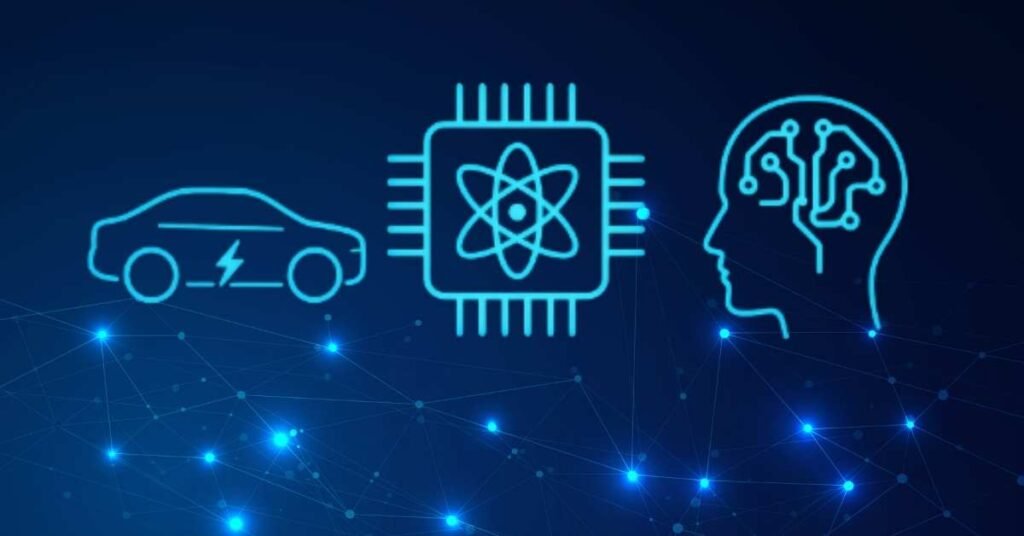
The intersection of Electric Vehicles (EVs), Quantum Computing, and Artificial Superintelligence (ASI) represents a future convergence of energy, computation, and intelligence, where each technology accelerates the others.
- EVs represent the physical, decentralized energy infrastructure.
- Quantum Computing acts as the engine for optimizing material science, battery design, and complex systems.
- ASI (or advanced AI) acts as the intelligent driver, using quantum-level computations to achieve superhuman optimization.
EV vs Quantum vs ASI: Understanding the Three Technologies Shaping the Next Decade

EV vs Quantum vs ASI represents three distinct technological revolutions happening simultaneously. Electric vehicles are already on your streets. Quantum computing is emerging from research labs. Artificial superintelligence is approaching faster than most people realize.
Each technology disrupts a different layer of civilization — transport, computation, and intelligence. Together, they’re not competing. They’re converging.
READ ALSO: AI Revolution in Industry 2026: 7 Powerful Shifts No One Is Ready For
Here’s why 2026 is the real inflection point:
- EVs crossed 17 million annual sales globally in 2024, per IEA data
- The quantum computing market is projected to hit $450 billion by 2030
- ASI timelines have compressed — leading researchers now estimate AGI within 3–10 years
Pro Tip: Follow all three technologies — missing one means missing the full picture.
Key Features Comparison Table
| Feature | Electric Vehicles | Quantum Computing | ASI |
|---|---|---|---|
| Current Stage | Commercial & scaling | Early experimental | Pre-emergence |
| Core Disruption | Transport & energy | Computation & pharma | Every sector |
| Biggest Barrier | Infrastructure & cost | Error correction | Alignment & safety |
| Impact Timeline | Now–2030 | 2030–2035 | 2035+ |
Electric Vehicles: How EV Innovation Is Transforming the Future of Mobility

Electric vehicles aren’t tomorrow’s promise — they’re today’s reality. The EV revolution has moved past the “early adopter” phase and into mainstream highways globally. In 2025, one in five new cars sold worldwide was electric.
The real innovation isn’t the motor. It’s the lithium-ion batteries powering everything underneath. Modern lithium-ion cells with a graphite anode and iron-phosphate cathode now deliver energy densities of 250–300 Wh/kg, enabling 300–500 km per charge with high cycle life and predictable performance.
Solid-state batteries are next. Toyota targets commercial solid-state EVs by 2027–2028, promising 300–500 Wh/kg — nearly double today’s best lithium-ion cells.
- EV battery demand is expected to reach 3,500 GWh annually by 2030
- Thermal runaway remains a latent danger in lithium-ion packs — solid-state tech eliminates this risk
- Scarce metals like cobalt and lithium create supply chain pressure — battery research is actively seeking alternatives
Pro Tip: Solid-state batteries will make today’s EVs look primitive — watch Toyota.
The EV story isn’t just about cars. Electric aviation, heavy freight electrification, and vehicle-to-grid (V2G) technology are turning EVs into distributed power assets. Your car could literally power your home during a grid outage.
The grid itself is the bottleneck. Charging 300 million EVs requires a fundamentally rebuilt electrical infrastructure — that’s the challenge nobody talks about enough.
Quantum Computing Explained: Why It Could Redefine the Power of Computation

Quantum computing doesn’t just solve problems faster — it solves problems classical computers can’t touch. A classical bit is either 0 or 1. A qubit exists in both states simultaneously, thanks to superposition. That’s not an incremental improvement. That’s a categorical leap.
Quantum simulation allows computers to model quantum mechanics at the molecular level — something classical machines approximate poorly. Drug discovery, materials science, and battery research all benefit enormously from this capability.
Real-world quantum wins are happening now:
- Drug discovery: Quantum simulation of protein folding accelerates pharmaceutical development — Evotec SE (EVO stock), a leading drug discovery and development collaborator in the Health Care sector, is already exploring quantum-assisted pipelines
- Cryptography: RSA encryption has a timeline problem — quantum computers will break it, which is why governments are already mandating post-quantum standards
- Battery research: Quantum mechanics-based molecular simulation is the slow grind in the lab that will eventually unlock next-gen EV batteries — reimagining materials from the atomic level up
Quantum-Si Incorporated (QSI stock) operates a unique platform in life sciences and innovation, using quantum-based protein sequencing. It’s a real example of quantum principles entering commercial life sciences tools and scientific services today.
The honest obstacle? Qubits are fragile. Decoherence — when qubits lose their quantum state — remains the core engineering problem. Fault-tolerant quantum computing is realistically a 2030–2035 milestone.
Artificial Superintelligence (ASI): The Next Evolution Beyond Artificial Intelligence

Artificial Intelligence today is narrow — brilliant at specific tasks, useless outside them. Artificial General Intelligence (AGI) matches human cognitive flexibility. ASI surpasses it. Across everything. Simultaneously.
That’s not science fiction. It’s a technical threshold that leading researchers believe is approaching within this decade.
The terminology matters:
- ANI (Artificial Narrow Intelligence) — what we have now: GPT-4, Gemini, Claude
- AGI — human-level reasoning across all domains
- ASI — superhuman intelligence, recursive self-improvement, exponential capability growth
What makes ASI categorically different from EVs and quantum computing is agency. EVs and quantum are tools — humans direct them. ASI pursues goals autonomously. That distinction changes everything about how we think about risk and governance.
Artificial Intelligence is already transforming stock analysis. Platforms like Danelfin use AI-powered rating systems that generate alpha signals — measuring stock probability, fundamental strength, technical indicators, and sentiment indicators to produce an AI Score for beating the market. Full AI analysis delivers data-driven insight with alpha signals, ATR volatility metrics, asset turnover, and cash per share data — offering investors a probability advantage with low risk indicators and low volatility flags.
The alignment problem is real. An ASI optimizing for a goal humans defined imprecisely could produce catastrophic outcomes — not from malice, but from precision. Getting the goal wrong is the danger.
Pro Tip: ASI alignment research today determines whether tomorrow’s superintelligence is safe.
Mobility, Computation, and Intelligence — How These Technologies Will Converge by 2035
Here’s what most analyses miss: EV vs Quantum vs ASI isn’t a competition. It’s a stack. Each technology amplifies the others in ways that will reshape entire industries.
The convergence is already starting
- AI-optimized EV routing reduces energy consumption by up to 15% in real-world tests
- Quantum simulation is accelerating materials science — directly improving EV batteries and discovering new organic liquid electrolyte formulations
- ASI-managed energy grids could dynamically balance supply and demand across millions of EVs simultaneously
Industry disruption scenarios by 2035
- Healthcare: Quantum simulation + AI diagnostics + electrified medical logistics — faster drug development, more accurate diagnoses, cleaner delivery
- Finance: Quantum breaks current encryption, forcing a complete infrastructure rebuild — stock comparison tools and investment platforms will need quantum-safe architecture
- Manufacturing: Autonomous factories designed by AI, optimized by quantum, powered by clean energy
- Defense: Nations controlling all three technologies gain decisive strategic advantages
The infrastructure gap is a quiet crisis. Electrical grids, rare earth supply chains, and data centers are the unglamorous backbone that everything depends on. Building them fast enough is the real race.
READ ALSO: Google Rolls Out “Private AI Compute” — A Secure Cloud Engine for Gemini Intelligence
Stock sector implications are significant. The healthcare sector, Life Sciences Tools & Services, biotech tools, and research tools industries will see the sharpest convergence impact. Industry ranking shifts will accelerate as quantum and AI reshape what top stocks look like across medical stocks and life sciences plays.
Pro Tip: Watch healthcare and energy infrastructure — convergence hits them first and hardest.
Technology Comparison: EV vs Quantum vs ASI Investment & Impact
| Category | EV | Quantum Computing | ASI |
|---|---|---|---|
| 2026 Market Size | ~$800B | ~$1.3B | ~$200B (AI broadly) |
| Projected 2030 Value | ~$2.5T | ~$450B | ~$15.7T (AI broadly) |
| Key Players | Tesla, BYD, Toyota | IBM, Google, IonQ | OpenAI, Anthropic, DeepMind |
| Investment Risk | Medium | High | Very High |
| Regulatory Pressure | Medium | Low | Very High |
Which Breakthrough Will Lead the Future of Technology in the Next Decade?
EV vs Quantum vs ASI each wins a different time horizon — and that’s the honest answer most articles won’t give you. The decade doesn’t belong to one technology. It belongs to a sequence.
The decade-by-decade framework
- 2026–2030: EVs dominate. Scaled, commercial, already reshaping energy and transport globally. Price evolution charts for top stocks in EV reflect this dominance — strong perf week, perf quarter, and perf YTD data back it up
- 2030–2035: Quantum delivers. Drug discovery, cryptography, and logistics optimization see real quantum-powered breakthroughs. Compare stocks like EVO vs QSI using data-driven platforms to identify better buy opportunities early
- 2035+: ASI changes the rules. Not just a better tool — a new kind of mind. Every projection made before it arrives becomes unreliable after
The verdict, plainly stated:
- EVs win on immediate, measurable impact — you can buy one today
- Quantum wins on transformative computational leverage — the payoff is enormous but delayed
- ASI wins on civilizational significance — with the highest uncertainty and the highest stakes
What this means for you
- Investors: Diversify across all three sectors — don’t bet on one horse in a three-horse race
- Business leaders: EVs demand attention now; quantum demands preparation; ASI demands governance thinking today
- Policymakers: Regulation is already behind capability development — the window to act responsibly is narrowing fast
READ ALSO: Gemini for TV Brings Powerful AI Streaming Experience to Millions of Google TV Users
Conclusion
EV vs Quantum vs ASI isn’t a debate with a clean winner. It’s a sequence unfolding in real time. EVs are remaking the world now. Quantum will unlock problems we currently can’t solve. And ASI — powered by boundless reasoning, human insight, and poetic curiosity about what intelligence can become — may redefine what “solving problems” even means. The smartest move is understanding all three. Not picking sides.
FAQs
What is quantum asi?
Quantum ASI refers to the idea of combining Artificial Superintelligence (ASI) with the power of quantum computing. It describes a super-intelligent AI that uses quantum computers to solve extremely complex problems far faster than humans or traditional computers.
Will quantum overtake AI?
No, quantum computing is unlikely to overtake AI because they serve different purposes. Instead, quantum computing may enhance AI, helping it solve complex problems faster and making advanced AI systems more powerful.
How is ASI different from AI?
Artificial Superintelligence (ASI) differs from standard Artificial Intelligence (AI) in its capabilities. ASI (Artificial Super Intelligence) is an extension of AI; however, ASI has effectively exceeded human intelligence through all means of cognitive thought, including reasoning, creativity, and problem-solving.
What is the difference between AI and quantum?
AI (Artificial Intelligence) refers to any form of computing that allows machines to learn, reason, and make decisions as if they were human. Quantum Computers are another form of computing, where computers use quantum mechanics to complete very complex and high-speed calculations. Therefore, although quantum technology helps enhance AI, the two technologies are also drastically different.
What does Elon Musk say about quantum computing?
Elon Musk has been quoted as stating he is fully amazed with all the advances made to date with quantum computing, stating that it is a very impressive technological advance. He also commented that quantum computing will have an enormous effect on future technology. He has yet to provide more detailed technical commentary about this matter.

Ansa is a highly experienced technical writer with deep knowledge of Artificial Intelligence, software technology, and emerging digital tools. She excels in breaking down complex concepts into clear, engaging, and actionable articles. Her work empowers readers to understand and implement the latest advancements in AI and technology.