
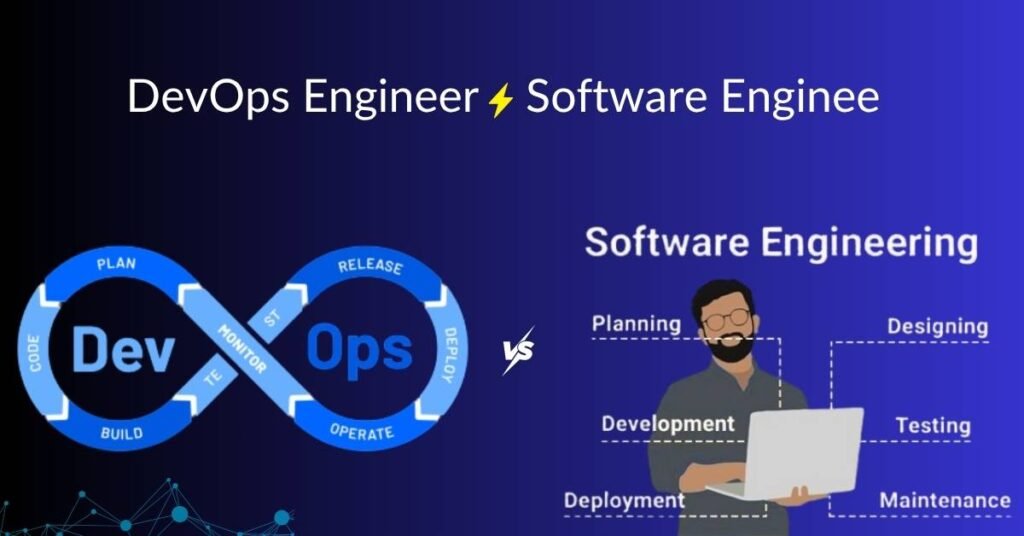
The difference between a DevOps Engineer and vs Software Engineer is arguably one of the most contentious comparisons of a career in the tech sector. Although both roles encourage innovation, the way in which they do so is quite different. Knowing the differences provides technology professionals with a better understanding of their potential career paths.
Today’s technology requires experts capable of simply using advanced systems. Software engineers prepare the products that the everyday consumer interacts with and utilizes. A DevOps engineer builds and upholds the surroundings that enable the utilization of those software applications.
This differentiation is illustrative of how cooperative and combined functions can help advance technology in the future. Both paths provide distinct challenges and opportunities to those who enjoy continual learning.
DevOps Engineer vs Software Engineer: The Real Innovation Power Behind Modern Tech
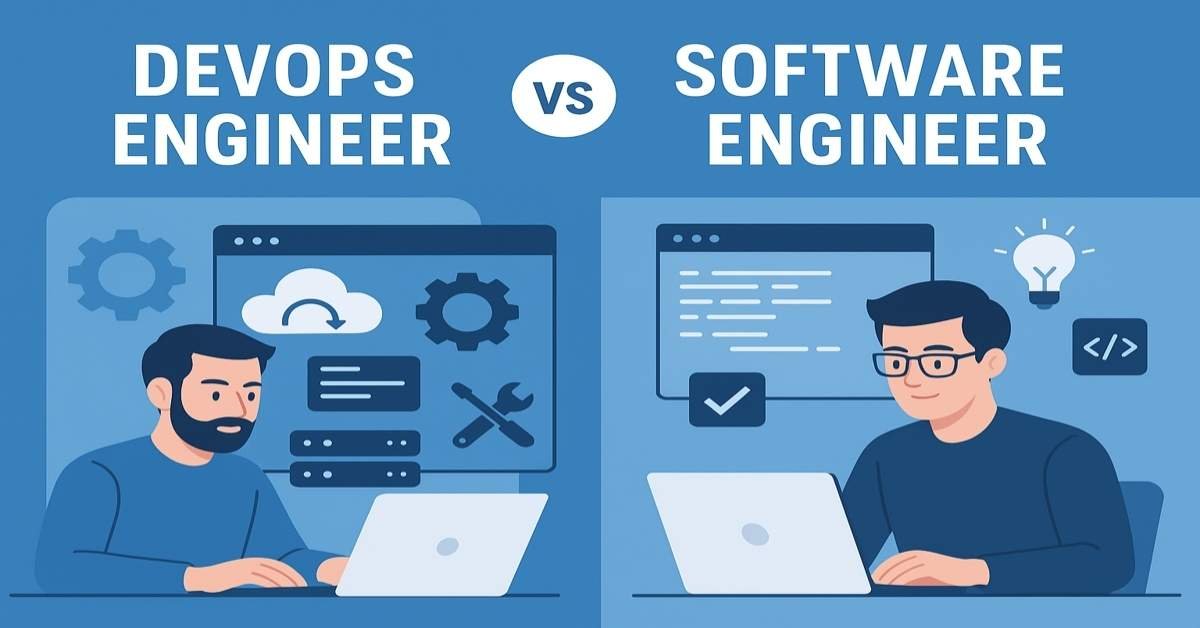
Software engineers are innovative by developing features that address the user’s problems directly. They develop systems that are aligned with business needs, resulting in functional applications. Their innovations show up in the functionality and visual of the product and the underlying algorithm that gives the product a competitive edge.
DevOps engineers are considered innovative due to the various practices they use, like infrastructure automation and reliability engineering. DevOps engineers take traditional continuous integration tools and put them to extensive use to minimize systems deployment times from weeks to minutes. They help provide confidence that applications will remain available in the event of a failure.
Netflix was the initiator of the concept of Chaos Engineering, introduced initially to allow users to test the resilience of their systems by breaking them on purpose as part of their DevOps role. This concept moved the company’s thinking about reliability in systems engineering to the next level. Netflix delivers 99.99% uptime for its 260 million subscribers to its services worldwide.
Key innovation areas
- Software engineers influence the product functionality and user experience.
- DevOps roles tend to be more focused on deployment speed and reliability.
- Both contribute to competitive advantage in entirely different ways.
- Collaboration multiplies the impact of innovations exponentially.
The symbiotic relationship between roles produces strong outcomes. Software engineers benefit from the speedy deployment cycles that the DevOps teams facilitate. DevOps engineers capitalize on the availability of applications that have better designs and are easier to maintain.
Companies implementing strong DevOps practices deploy 46 times more frequently than low performers. They recover from incidents 2,604 times faster, according to State of DevOps Report findings.
According to Glassdoor’s 2025 data, senior software engineers earn between $140,000 and $185,000 a year. Senior DevOps engineers earn between $145,000 and $195,000 or more based on their experience with cloud services, which is likely highly compensated.
DevOps Engineer vs Software Engineer: Which Career Path Dominates the Future of Tech?
Neither path dominates because tech ecosystems need both to function together. LinkedIn’s 2025 Workforce Report shows 28% growth in DevOps positions. Software development positions grew 23% simultaneously.
The barriers to entry on career paths chosen by professionals vary significantly. To be a software engineer, you must know a lot about data structures and how to design software. Coding bootcamps made this accessible for many, with programs covering from $7,000-21,000.
DevOps roles demand broader, initially shallower knowledge across multiple domains. You need scripting abilities, networking fundamentals, and cloud platform familiarity. Many transition from system administration into DevOps after gaining experience.
Career progression differences
- Software engineers: Junior → Mid → Senior → Staff → Principal
- DevOps paths: Junior → Mid → Senior → SRE → Platform Engineer
- Both tracks offer individual contributor and management options
- Remote career opportunities are abundant for both roles
Software engineers in their first job typically earn between $75,000-$90,000 in major tech hubs. For a DevOps engineer in their first role, average entry-level compensation starts at $80,000-$95,000, reflecting the broader skill set required.
At senior levels, total compensation, including equity, grows to over $300,000 for both job categories. Staff+ engineers at FAANG companies average between $400,000-$600,000 in total compensation packages.
Automation affects careers differently based on how artificial intelligence is applied. For instance, GitHub Copilot and generative AI take on routine coding tasks to an even greater extent. While DevOps automation continues to advance, it seems that the increase in complexity around distributed systems and architectures outpaces it.
The Innovation Engine: How DevOps and Software Teams Shape the Future of Development

The software development life cycle has been transformed by continuous integration and deployment pipelines. Thanks to automation tools, businesses can deploy features multiple times per day. Spotify leverages its practices to deploy over 10,000 times across all systems each day.
Monitoring and observability tools illuminate the interactions users have with features. This information plays an important role in architecture decisions and feature prioritization decisions for engineers. Kubernetes unleashed the microservices revolution by solving the challenges surrounding orchestration.
Infrastructure as code changed the way teams think about development experience in environments. Terraform (and SCM tools) allow engineers to version control entire data centers. There is no longer a need for “it worked on my machine.”
Collaborative patterns:
- Blameless postmortems turn failures into learning opportunities
- Shared ownership eliminates the “throw over the wall” mentality
- Platform teams build self-service tools for developers
- Feature flags enable safe production experimentation
Feature flags are a Modern DevOps innovation that have enabled experimentation with product features safely in production contexts. Teams can deploy code into production, but are only able to “turn on” features for certain segments. This does two things: reduces risk while simultaneously enabling developers to iterate through learning cycles much faster.
Amazon’s “you build it, you run it” is a quintessential example of modern culture. An engineer who maintains a service develops a much deeper understanding of operational concerns. That sense of ownership and accountability drives engineers to think more about how they design software up front.
From Code to Cloud: The Evolving Roles Powering Modern Tech Careers
The software development life cycle looked radically different fifteen years ago. Waterfall methodology is dominated by six-month release cycles. Separate operations teams handled deployments, creating friction between groups.
AWS, which came out in 2006, forever changed the possible infrastructure. No longer would teams take weeks to provision servers. Just having access to cloud infrastructure led to the DevOps movement around 2009.
Then came container technology with Docker and Kubernetes, which expanded the use of cloud computing even faster. They enabled development teams to seamlessly deploy applications across cloud platforms. With Docker and Kubernetes, development teams had unprecedented control over their runtime environments.
Technology shifts reshaping roles:
- Infrastructure as code is quickly evolving into a standard practice in the industry
- GitOps is quickly replacing manual configuration management and processes
- Service mesh solves the complexities of microservices effectively
- Observability platforms offer a new solution to traditional monitoring techniques.
Today’s software engineers must understand the cloud services where their code runs. Minimum expectations are now basic knowledge of Docker, along with familiarity with CI/CD pipelines. The full-stack developer now also needs to have some awareness of the infrastructure.
Site Reliability Engineering emerged from Google’s operations approach successfully. SREs blend software engineering with operations expertise seamlessly. Senior positions command $160,000-$210,000 according to 2025 market data.
Skillset Evolution: What Modern Tech Professionals Need to Thrive in an Innovation-Driven Era
Programming languages continue to be a foundation for all software engineers today. Job postings still list Python, JavaScript/TypeScript, and Go as the most valuable programming languages. Even Rust is gaining traction in situations where memory safety is demanded and systems programming is underway.
System design clearly demarcates mid-level software engineers from senior software engineers. Patterns for scalability and optimization around databases become very important at this level. These skills really matter when it comes to the performance of an application and cost savings.
First, DevOps people should get strong experience in one main cloud platform. AWS has a 32% market share. Azure follows with 23%. Deep familiarity with a single platform is more valuable than shallow familiarity with multiple clouds.
| Skill Category | Software Engineer Skills | DevOps Engineer Skills |
|---|---|---|
| Core Programming | Programming languages (Python, Java, JavaScript) | Scripting languages (Python, Bash, PowerShell) |
| Technical Foundation | Data structures and algorithms | Networking and security fundamentals |
| Architecture | Software architecture and design patterns | Infrastructure as Code (Terraform, Ansible) |
| Application Design | API design and microservices | Container orchestration (Kubernetes) |
| Data Management | Database optimization (SQL/NoSQL) | Cloud storage and cloud management |
| Quality & Testing | Software testing and debugging | Monitoring tools (Prometheus, Datadog) |
| Version Control | Version control (Git) | SCM tools and GitOps practices |
| Cloud & Infrastructure | Cloud services integration | Cloud platforms (AWS, Azure, GCP) |
| Deployment | Integrated development environments | CI/CD tools (Jenkins, GitHub Actions) |
Essential soft skills
- Interaction between technical and business stakeholders.
- Written documentation is a knowledge transfer mechanism.
- Incident management and crisis decision-making.
- Mentoring and knowledge transfer abilities.
Cloud certifications can greatly enhance your DevOps career by showcasing validation. The AWS Solutions Architect Associate certification costs $150 and validates knowledge of AWS. The Certified Kubernetes Administrator certification validates knowledge of container orchestration, a skill that is in high demand.
Approximately $39-$99 per month. Google’s Cloud Engineer certificate program is offered at $49 per month, lasting anywhere from 3 to 6 months. These certificates indicate a dedication to learning cloud technologies.
Employing test automation skill sets allows software and DevOps roles to crossover effectively. Understanding different phases of testing will make you write better code and pipelines. Presently, testing frameworks for web, such as Selenium, Cypress, and Playwright, are the leaders in the testing arena.
Career Growth in Tech: Why Innovation, Not Just Coding, Defines Success Today

Just being technically excellent does not guarantee a career anymore. Being able to gauge business impact is valued more than elegant code. Companies are looking for engineers who understand how their work contributes to revenue.
Visible innovation promotes faster advancement in a career than heads-down coding. Internal technical talks are a way to share info and establish standing. Documentation is a way to showcase thought leadership without being in an official management role.
For senior-level promotions, influence must go beyond one’s team. Staff engineers influence the technical direction for entire organizations. They propose architectural improvements that impact multiple teams.
Innovation metrics advancing careers
- Frequent Deployments via Automation
- System reliability increases in system uptime percentage.
- Overall cost optimizations are driven largely by improved infrastructure efficiency.
- Unlocking new capabilities for improved revenue.
Many engineers are completely taken by surprise by this promotion paradox. Senior+ roles involve less coding and more decision-making, while technical leadership paths allow you to remain hands-on while still having a say in the strategy.
The compensation ranges from $250,000 to $400,000. These positions generally require eight to twelve years of experience and a track record of impact. The career path focuses on strategic thought rather than speed of implementation.
DevOps engineers grow their mastery by building platforms that multiply productivity. The impact is achieved by creating internal developer platforms that reduce the friction of deployment. And quantifiable time savings can help to rationalize why you get promoted.
Collaboration is the New Code: How Cross-Functional Teams Redefine Tech Efficiency
The myth of lone genius programming is dead with distributed systems. Modern applications require coordination between frontend, backend, and DevOps teams. Communication skills are equally valuable as technical skills.
Spotify’s squad model organizes engineers into autonomous teams. Each squad includes software engineers, DevOps roles, and designers. This structure accelerates decision-making by eliminating approval chains.
Request for Comments documents let teams propose changes, gathering feedback. Architecture Decision Records document why teams made specific choices. These practices support asynchronous communication across time zones.
Modern collaboration practices
- Pair programming for sharing knowledge
- Code review culture to catch bugs early
- Shared on-call responsibilities, building empathy
- Cross-training reduces single points of failure
Breaking down silos between development and operations defines culture. Shared metrics align teams toward common goals. When developers share on-call, they experience poor design consequences.
Joint retrospectives between software and DevOps teams identify improvements. These meetings focus on systems rather than individuals. A blameless culture enables honest discussion about failures.
Automation, AI, and the Human Factor: The Future of Engineering Careers
Artificial intelligence writes functional code now through GitHub Copilot. Machine learning models autocomplete functions and generate boilerplate. Software engineers spend less time on routine implementation.
Generative AI impacts junior positions more than senior roles. Entry-level coding tasks become automated, raising expectations. Companies still need engineers to understand when AI-generated code fits.
Incident response platforms enabled by artificial intelligence take DevOps automation to new levels of sophistication. These tools analyze patterns in metrics from code repositories, CI/CD pipelines, and production to predict outages before they happen. Automated remediation allows for the automated response to common issues without human intervention.
What AI cannot replace
- Gathering requirements with stakeholders.
- System design and choices regarding architecture.
- Negotiation and alignment with other teams.
- Managing change in culture.
- Understanding context and applying business judgement.
Seasoned engineers focusing on judgment are still valuable. These positions are based on understanding the business context that AI does not. More than speed, it is important to understand what questions to ask.
Responsible AI practices create different types of specialization opportunities. MLOps engineers operationalize machine learning models at scale. This field brings together software development, DevOps-type roles, and data science.
Innovation Leadership: How Tech Professionals Drive Digital Transformation
Technical leadership doesn’t require people management responsibilities. Staff+engineer tracks let individual contributors influence architecture. These roles shape the standards that entire engineering organizations follow.
To secure executive buy-in for digital transformation initiatives, organizations will need to identify and appoint technical champions. Engineers are asked to explain the trade-offs between cost and risk for cloud migration efforts, and effective communication with non-technical stakeholders enables faster adoption.
Building political capital is also important. It is important to understand the motivations of various stakeholders and to provide a return on investment. Just being the smartest person in the room doesn’t mean the finance team will approve the spending initiative.
Leadership qualities
- Vision seeing possibilities others miss
- Evangelism builds enthusiasm for approaches
- Risk management: Knowing when innovation is worth the costs
- Measurement proving value through concrete metrics
Capital One’s cloud journey exemplifies successful transformation leadership. The company moved entirely to AWS by 2020. Technical leaders convinced executives that cloud security could exceed on-premises approaches.
Platform engineering is an evolution of DevOps thinking and practices that emphasizes product thinking. Internal developer platforms are designed to abstract complexity away so that application teams do not have to deal with as much complexity. Creating these platforms requires empathy for user needs and the ability to design an experience.
The Next Wave of Tech Careers: Innovation Roles Shaping the Industry
The last few years have seen the emergence of Platform Engineer as a unique specialization. Internal developer platforms are the product of these professionals, whose work involves simplifying the whole process. The demand for their services has increased dramatically as organizations have become aware that the complexity of the cloud is a major barrier to productivity.
The Site Reliability Engineering practice has been adopted across the industry, not just within Google. SREs using error budgets manage the trade-off between feature delivery and system downtime. Such positions are mainly concerned with system design and the implementation of automated processes.
The function of a Security Engineer incorporates DevSecOps principles directly into the development process, which allows for the identification of security breaches at the design stage. Such positions are demanding, and the salary range is $150,000-$220,000, which indicates the significance of these roles.
Emerging high-demand roles
- MLOps Engineer implementing machine learning.
- FinOps Specialist improving cloud spending.
- Chaos Engineer assessing system durability.
- Developer Advocate connecting technical communication.
Cloud engineer roles pay more attention to multi-cloud and hybrid cloud deployments. To prevent vendor lock-in, firms allocate their workloads among different platforms. Engineers who are responsible for this complicated situation get high salaries.
Green computing creates new specialization areas for sustainability. Data centers consume 1% of global electricity. Engineers optimizing resource usage address corporate responsibility mandates.
FAQs
What’s the main difference between a DevOps Engineer and vs Software Engineer role?
The software engineers are the ones who write the application code that the end users deal with. On the other hand, the DevOps engineers do the infrastructure and automation tools, apart from giving a reliable delivery of applications. They all code, but their problems are different.
Which pays more: a DevOps Engineer or vs Software Engineer position?
Compensation remains comparable between the two career paths. Senior DevOps engineers average $145,000-$195,000 annually. Senior software engineers earn $140,000-$185,000. Cloud services expertise impacts salary potential significantly.
Can software engineers transition to DevOps roles?
Indeed, a great number of DevOps specialists began their careers as developers. The switch involves gaining knowledge about cloud services and the use of code for managing infrastructure. Knowledge of the software development process aids in the creation of more effective automation workflows.
Do I need a professional certificate for these careers?
While formal degrees are an advantage, their possession is not obligatory for both parties. It is common for software engineers to have degrees in computer science or to be certified through a coding bootcamp. Cloud certification that shows one’s practical capabilities is one of the most valuable things a DevOps engineer can acquire.
How does artificial intelligence impact job security?
AI automates routine tasks but creates new opportunities. Machine learning helps software engineers code faster. DevOps automation advances, but systems complexity grows faster. Both careers remain secure for continuous learners.
Conclusion
DevOps Engineer and Software Engineer are not competing paths but rather complementary ones. Both roles are responsible for technological innovation, just in different ways. Where software development revolves around feature enhancement, DevOps takes care of the product’s release.
Digital transformation is taking place worldwide at a faster rate, and as a result, there will be many job opportunities in this field. Projections indicate that the job outlook will remain robust up to 2030. Knowing your strengths is more important than picking the best roles.

Ansa is a highly experienced technical writer with deep knowledge of Artificial Intelligence, software technology, and emerging digital tools. She excels in breaking down complex concepts into clear, engaging, and actionable articles. Her work empowers readers to understand and implement the latest advancements in AI and technology.