Skip to content
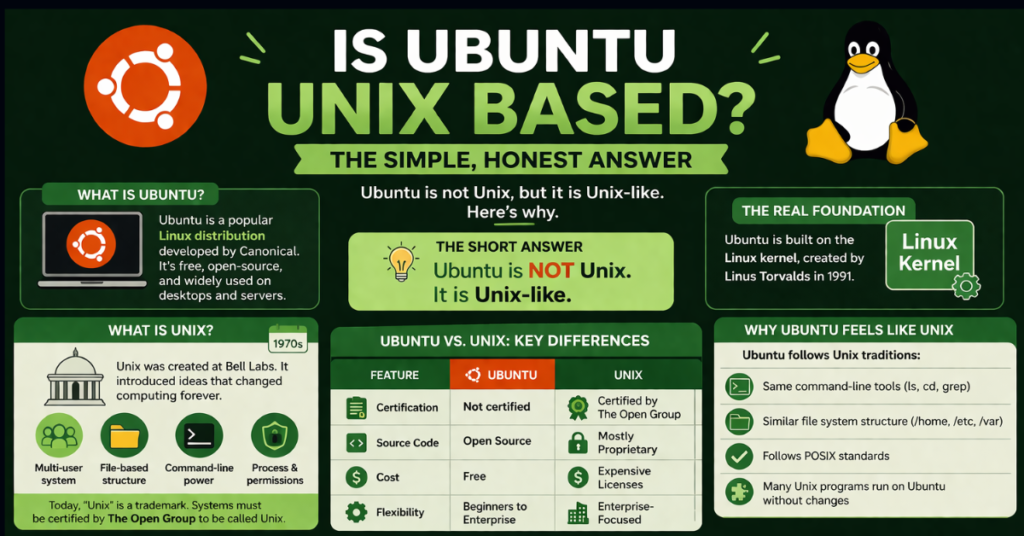
If you’ve ever searched “is Ubuntu Unix based”, you probably ran into confusing answers. Some say yes. Some say no. Some throw in terms like “Unix-like” and disappear.
I’ve been there too.
So let me break it down in a simple, factual, and no-nonsense way—based on how systems actually work, not just buzzwords.
What Is Ubuntu, Really?
Ubuntu is a popular operating system built on top of the Linux kernel. It’s maintained by Canonical Ltd. and widely used for desktops, servers, and cloud environments.
I personally like Ubuntu because it balances power and simplicity. It gives me the flexibility of Linux without making me feel like I need a PhD just to install software.
But here’s the key point:
Ubuntu is not Unix.
Then Why Do People Confuse Ubuntu With Unix?
This is where things get interesting.
Ubuntu belongs to a family of systems inspired by UNIX. That family is often called Unix-like systems.
So when someone says Ubuntu is “Unix-based,” what they usually mean is:
Ubuntu behaves like Unix, but it is not officially Unix.
What Is Unix (And Why It Matters)?
Unix started in the 1970s at Bell Labs. It introduced concepts that changed computing forever:
Multi-user system
File-based structure
Powerful command-line tools
Process control and permissions
Modern systems still rely heavily on these ideas.
But here’s the catch:
“Unix” today is a trademark and certification, not just a concept.
To officially call something “Unix,” it must meet standards set by The Open Group.
Examples of certified Unix systems:
macOS (yes, Apple did the paperwork)
IBM AIX
HP-UX
Ubuntu? Not certified.
So Is Ubuntu Unix-Based or Not?
Let me answer this directly:
Ubuntu is not Unix-based, but it is Unix-like.
That’s the most accurate and SEO-friendly answer you’ll find.
The Real Foundation of Ubuntu
Ubuntu is based on:
Linux kernel
Linux was created by Linus Torvalds in 1991. He built it as a free and open-source alternative inspired by Unix.
So technically:
Unix → Inspired Linux
Linux → Powers Ubuntu
It’s like saying:
Ubuntu is the grandchild of Unix, not the child.
Key Differences: Ubuntu vs Unix
Let me simplify things with real-world logic instead of textbook jargon.
1. Certification
Unix: Certified by The Open Group
Ubuntu: No certification
This alone makes Ubuntu “not Unix.”
2. Source Code
Unix: Mostly proprietary
Ubuntu: Fully open source
I can literally view and modify Ubuntu’s code. Try doing that with traditional Unix systems—you’ll hit a wall faster than your Wi-Fi during a storm.
3. Cost
Unix systems: Expensive licenses
Ubuntu: Free
Yes, free as in “download it and use it without paying a rupee.”
4. Flexibility
Unix: Enterprise-focused
Ubuntu: Beginner to advanced users
Ubuntu works for:
Students
Developers
Startups
Enterprises
That versatility is why it dominates cloud environments.
Why Ubuntu Feels Like Unix
Even though Ubuntu isn’t Unix, it behaves very similarly.
Here’s why:
1. Same Command-Line Philosophy
Commands like:
ls
cd
grep
All come from Unix traditions.
When I first used Ubuntu, I realized I could follow Unix tutorials without much trouble.
2. File System Structure
Ubuntu uses a hierarchical structure:
/home
/etc
/var
This layout comes directly from Unix design.
3. POSIX Compliance
Ubuntu follows standards like POSIX (Portable Operating System Interface), which ensures compatibility with Unix behavior.
That’s why many Unix programs run smoothly on Ubuntu.
Why This Question Matters (More Than You Think)
You might think:
“Okay, cool… but why does this even matter?”
Fair question.
Here’s where it actually matters:
1. For Developers
If you’re coding, especially backend or DevOps:
Ubuntu gives you a Unix-like environment without licensing headaches.
That’s why tools like Docker, Kubernetes, and Node.js thrive on Ubuntu.
2. For Career Growth
Companies don’t always require “Unix experience.”
They usually ask for:
“Unix/Linux experience”
And Ubuntu qualifies.
3. For Server Infrastructure
Most cloud servers run Linux-based systems.
Ubuntu dominates platforms like AWS and Azure.
So even though it’s not Unix, it plays in the same league.
Common Myths (Let’s Clear Them Up)
Myth 1: Ubuntu is Unix
False
It’s Unix-like, not Unix.
Myth 2: Linux = Unix
Not exactly
Linux is inspired by Unix, but it’s a separate system.
Myth 3: You need Unix to learn programming
Nope
Ubuntu works perfectly for development.
A Simple Analogy (That Actually Makes Sense)
Think of Unix as the original recipe.
Linux is a recreation of that recipe.
Ubuntu is a polished dish made using Linux.
Same taste. Different kitchen.
Trusted Sources (For Transparency)
I always prefer facts over guesswork. Here are reliable references:
The Open Group (Unix certification authority)
Canonical (Ubuntu official documentation)
GNU/Linux documentation
POSIX standards documentation
These sources confirm:
Ubuntu is not certified Unix, but it follows Unix principles.
Final Verdict (Short & Clear)
Let me wrap this up without confusion:
Ubuntu is not Unix-based
Ubuntu is Unix-like
Ubuntu uses the Linux kernel
Ubuntu follows Unix design principles
My Honest Take
If you ask me whether Ubuntu is “good enough” compared to Unix, I’d say:
It’s more practical for most people.
You get:
Power
Flexibility
Zero cost
Massive community support
Unless you work in a niche enterprise environment that requires certified Unix, Ubuntu will do everything you need—and probably faster.
Quick FAQ
Is Ubuntu a Unix system?
No. It’s Unix-like, not officially Unix.
Why does Ubuntu feel like Unix?
Because it follows Unix principles and standards.
Should I learn Ubuntu instead of Unix?
Yes. It’s more accessible and widely used today.

Ansa is a highly experienced technical writer with deep knowledge of Artificial Intelligence, software technology, and emerging digital tools. She excels in breaking down complex concepts into clear, engaging, and actionable articles. Her work empowers readers to understand and implement the latest advancements in AI and technology.