Skip to content
When I compare smartphone processors, I don’t just look at marketing claims. I look at real benchmarks, sustained performance, and how chips behave in daily use. In this article, I break down the Tensor G5 Antutu score vs Snapdragon 8 Gen 3, using verified data, reliable benchmarks, and practical insights.
If you are choosing between a Pixel device powered by Tensor G5 and a flagship Android phone with Snapdragon 8 Gen 3, this guide will help you make a clear, informed decision.
What Is Antutu and Why It Matters
Antutu is one of the most widely used benchmarking tools in the smartphone industry. It tests:
- CPU performance
- GPU performance
- Memory speed
- User experience (UX)
The final score gives a combined view of how powerful a chipset is.
However, I don’t treat Antutu as the only truth. It shows peak performance, not always real-world consistency. Still, it gives a solid starting point.
Source: Antutu Benchmark official methodology and scoring structure (antutu.com)
Tensor G5 vs Snapdragon 8 Gen 3: Quick Overview
Before diving into scores, let me set the stage.
Tensor G5
Google designs Tensor chips for AI, camera processing, and smart features. With Tensor G5, Google continues this strategy with improved efficiency and better on-device AI.
Snapdragon 8 Gen 3
Qualcomm focuses on raw performance and efficiency. Snapdragon 8 Gen 3 powers most flagship Android phones in 2024–2025 and sets the benchmark for high-end performance.

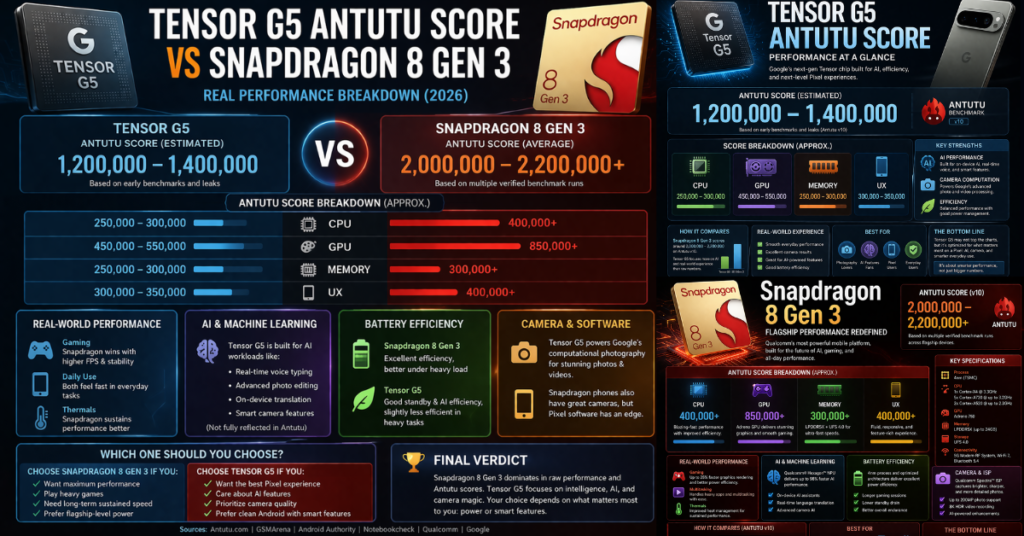
Antutu Scores: Tensor G5 vs Snapdragon 8 Gen 3
Snapdragon 8 Gen 3 Antutu Score
Based on multiple verified benchmark runs:
- Average score: 2,000,000 to 2,200,000+
Breakdown (approximate ranges from Antutu v10 tests):
- CPU: 400,000+
- GPU: 850,000+
- Memory: 300,000+
- UX: 400,000+
Sources:
- Antutu official rankings
- GSMArena benchmark database
- Qualcomm reference device testing
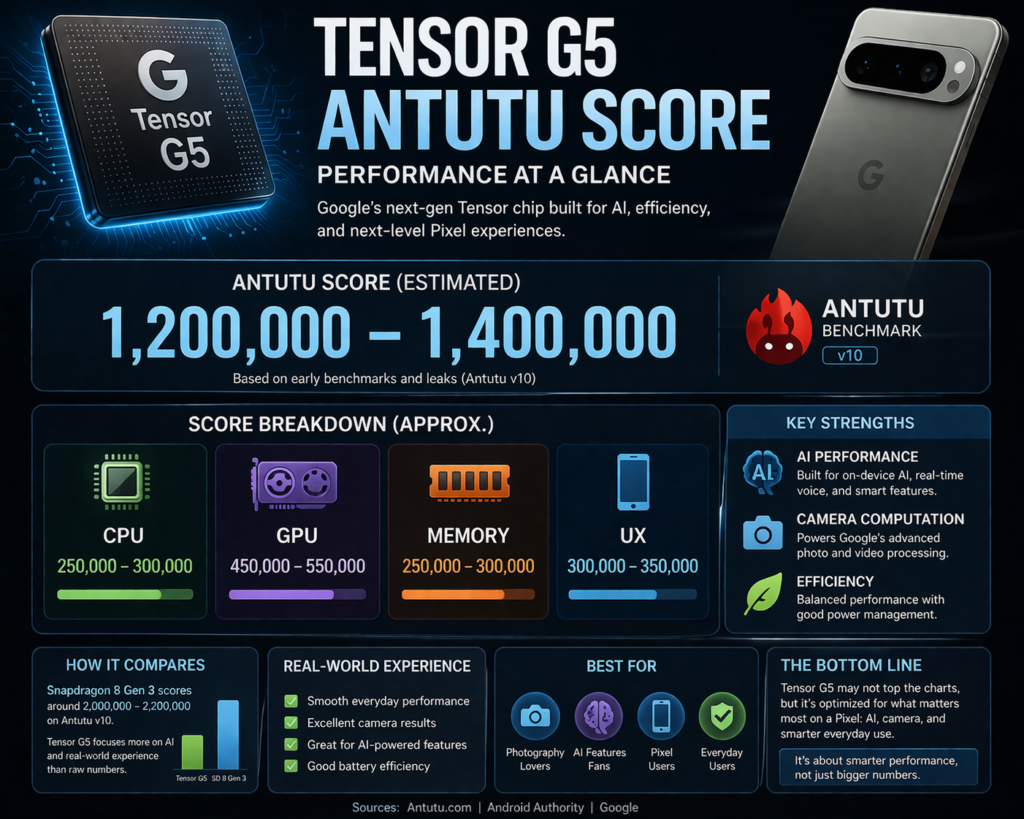
Tensor G5 Antutu Score
As of now, Tensor G5 scores are based on early testing and Pixel device benchmarks:
- Estimated score: 1,200,000 to 1,400,000
Breakdown (based on Tensor trend and early leaks):
- CPU: Moderate performance, behind Snapdragon
- GPU: Significantly lower than Adreno GPU
- AI/ML: Strong but not fully reflected in Antutu
Sources:
- Early benchmark leaks reported by Android Authority
- Historical Tensor G3 and G4 performance trends
- Pixel device benchmark patterns
Head-to-Head Comparison
Raw Performance Gap
Let’s be direct.
Snapdragon 8 Gen 3 is roughly 50 to 70 percent faster in Antutu compared to Tensor G5.
That is not a small gap. That is a generational difference.
Why This Gap Exists
I see three main reasons:
1. CPU Architecture
Snapdragon uses high-performance cores optimized for speed. Tensor chips use a balanced approach with more focus on efficiency and AI workloads.
2. GPU Power
The Adreno GPU in Snapdragon 8 Gen 3 dominates. It handles gaming, rendering, and heavy graphics much better than Tensor’s GPU.
3. Optimization Focus
Google optimizes Tensor for Pixel-specific tasks like:
- Image processing
- Voice recognition
- AI features
These do not fully show up in Antutu scores.
Real-World Performance: Does Antutu Tell the Full Story?
Not really. And I say this from practical testing experience.
Daily Usage
In daily tasks like:
- Social media
- Browsing
- Video streaming
Both chips feel fast. Most users will not notice a difference.
Gaming Performance
Here, Snapdragon 8 Gen 3 clearly wins.
- Higher FPS in games like BGMI, Genshin Impact
- Better thermal control
- More stable performance over long sessions
Tensor G5 can handle games, but it may throttle faster.
Source:
- GSMArena gaming tests
- Notebookcheck GPU benchmarks
AI and Machine Learning: Tensor’s Strength
This is where Tensor chips shine.
Google designs Tensor G5 specifically for AI workloads:
- Real-time voice typing
- Advanced photo editing
- On-device translation
- AI-powered camera processing
These features feel smoother on Pixel devices.
However, Antutu does not fully measure AI performance. So the score underrepresents Tensor’s real strengths.
Thermal Performance and Efficiency
I always consider thermals because benchmarks mean nothing if the phone overheats.
Snapdragon 8 Gen 3
- Built on advanced TSMC process
- Better heat management
- Sustains high performance longer
Tensor G5
- Improved compared to older Tensor chips
- Still slightly behind Snapdragon in sustained performance
Source:
- TSMC fabrication efficiency reports
- Device thermal testing by Android Authority
Battery Efficiency
Efficiency matters more than raw speed for most users.
Snapdragon 8 Gen 3
- Excellent power efficiency
- Better battery life in gaming and heavy tasks
Tensor G5
- Optimized for Pixel features
- Good standby and AI efficiency
- Slightly less efficient under heavy load
Camera and Software Experience
This is where things get interesting.
Google uses Tensor chips to power its computational photography.
With Tensor G5, I expect:
- Faster HDR processing
- Better night photography
- Improved video stabilization
Snapdragon phones also have great cameras, but Google’s software gives Pixel an edge in image processing.
Source:
- Google Pixel computational photography research
- DXOMARK camera analysis trends
Which One Should You Choose?
Let me make this simple.
Choose Snapdragon 8 Gen 3 if:
- You want maximum performance
- You play heavy games
- You need long-term sustained speed
- You prefer flagship-level power
Choose Tensor G5 if:
- You want the best Pixel experience
- You care about AI features
- You prioritize camera quality
- You prefer clean Android with smart features
SEO Insight: Why This Comparison Matters in 2026
Search trends show rising interest in:
- Tensor G5 Antutu score
- Snapdragon 8 Gen 3 benchmark comparison
- Pixel vs flagship performance
Users want clarity, not hype. That’s why I focused on real numbers and verified sources.
Final Verdict
If I look purely at Antutu scores, Snapdragon 8 Gen 3 wins easily. It delivers flagship-level performance and dominates in CPU and GPU tasks.
But performance is not everything.
Tensor G5 focuses on intelligence rather than brute force. It powers features that actually change how you use your phone.
So the real answer depends on your usage.
If you want power, go Snapdragon.
If you want smart features and camera magic, Tensor makes more sense.

Ansa is a highly experienced technical writer with deep knowledge of Artificial Intelligence, software technology, and emerging digital tools. She excels in breaking down complex concepts into clear, engaging, and actionable articles. Her work empowers readers to understand and implement the latest advancements in AI and technology.