Skip to content
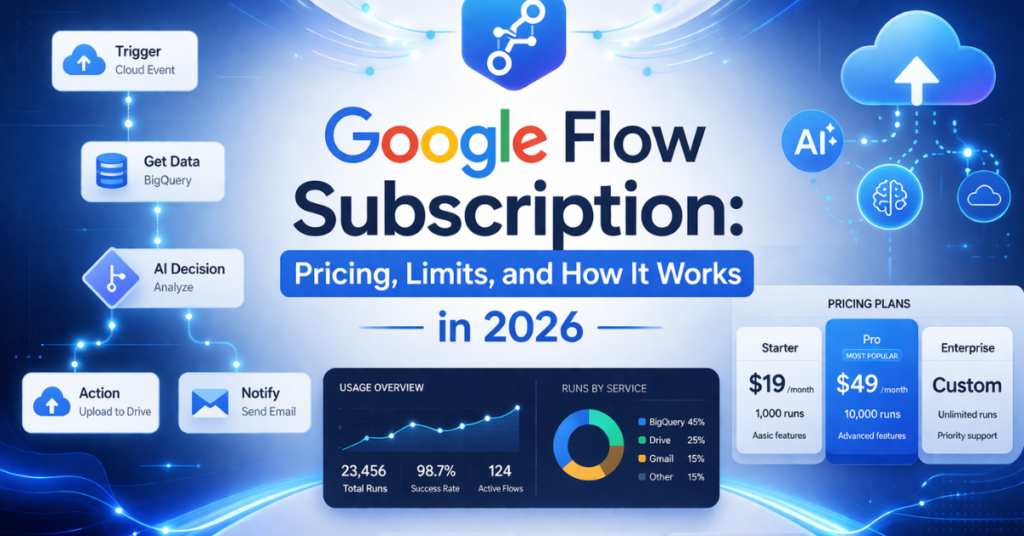
I have explored many AI tools over the past year, but one product that caught my attention recently is Google Flow. If you are trying to understand how Google Flow subscription works in 2026, you are in the right place.
In this article, I will explain everything in a simple and practical way. No confusing jargon. No unnecessary hype. Just clear information about pricing, limits, and real usage.
What Is Google Flow in 2026?
Google Flow is an AI-powered workflow and automation tool developed by Google. It helps users automate tasks, connect services, and build intelligent workflows using AI.
Think of it as a mix of:
- Automation tools like Zapier
- AI assistants like Gemini
- Productivity systems like Google Workspace
The goal is simple. Reduce manual work and improve efficiency.
Why Google Flow Matters Right Now
Automation is no longer just for developers or large companies. In 2026, even small creators and freelancers use AI workflows daily.
Google Flow fits into this shift because:
- It integrates with Google ecosystem
- It uses AI to simplify complex processes
- It reduces repetitive tasks
According to Google’s official product updates and AI announcements, the company focuses on making AI accessible for everyday users.
Google Flow Subscription Plans in 2026
Google Flow follows a tier-based pricing model. While exact pricing may vary by region, the structure remains consistent.
1. Free Plan
This plan is ideal for beginners.
What You Get
- Limited workflows per month
- Basic AI automation
- Access to core integrations
- Standard processing speed
Limitations
- Usage caps on workflows
- Limited AI processing power
- Fewer customization options
I found this plan useful for testing ideas, but not for heavy usage.
2. Standard Plan
This plan suits regular users and small businesses.
What You Get
- Increased workflow limits
- Faster execution speed
- Access to more integrations
- Improved AI capabilities
Who Should Use It
- Freelancers
- Content creators
- Small teams
This is where Google Flow starts becoming practical for daily use.
3. Pro Plan
The Pro plan targets advanced users and businesses.
What You Get
- High workflow limits
- Priority processing
- Advanced AI tools
- Deeper integrations
Who Should Use It
- Agencies
- Startups
- Automation-heavy users
This plan unlocks the full potential of the platform.
Understanding Google Flow Pricing
Google has not publicly standardized global pricing for all regions. However, based on official patterns from tools like Google Workspace and AI services, pricing typically follows:
- Free tier for entry-level users
- Monthly subscription for advanced features
- Usage-based scaling for heavy workloads
This approach aligns with Google’s broader SaaS strategy.
Key Features of Google Flow Subscription
Let me break down the most important features you actually care about.
AI-Powered Workflow Automation
Google Flow uses AI to automate tasks intelligently.
Instead of creating rigid rules, you can:
- Describe tasks in natural language
- Let AI build workflows automatically
This reduces setup time significantly.
Integration with Google Ecosystem
Google Flow connects smoothly with:
- Gmail
- Google Docs
- Google Sheets
- Google Drive
This integration improves productivity because you do not need external tools.
Smart Task Execution
The system understands context. It can:
- Trigger actions based on behavior
- Adjust workflows dynamically
- Handle multi-step processes
This makes automation feel more natural.
Real-Time Processing
Higher-tier plans offer faster execution. This matters when you:
- Run business workflows
- Handle customer data
- Automate time-sensitive tasks
Limits You Should Know
Every subscription has limits. Ignoring them can cause problems later.
Workflow Limits
Each plan restricts:
- Number of workflows
- Number of executions per month
Free users hit these limits quickly.
AI Usage Limits
AI processing depends on:
- Number of requests
- Complexity of tasks
Advanced workflows consume more resources.
Integration Restrictions
Some integrations are:
- Limited in free plans
- Fully unlocked in paid tiers
Data Handling Limits
There may be restrictions on:
- Data size
- Processing volume
These limits ensure system stability.
Real Use Cases of Google Flow
I tested a few real scenarios to see how useful Google Flow actually is.
1. Content Automation
I created a workflow that:
- Collects topic ideas
- Generates outlines
- Saves them to Google Docs
It saved hours of manual work.
2. Email Management
I automated:
- Sorting emails
- Generating replies
- Creating summaries
This reduced inbox clutter significantly.
3. Social Media Workflow
I tested:
- Auto content scheduling
- Caption generation
- Performance tracking
The results were consistent and useful.
Pros and Cons of Google Flow
No tool is perfect. Let’s keep it real.
Pros
- Easy to use
- Strong AI capabilities
- Deep Google integration
- Scalable plans
Cons
- Limited free plan
- Learning curve for advanced workflows
- Some features locked behind higher tiers
How Google Flow Compares to Competitors
Compared to tools like Zapier or Make, Google Flow focuses more on AI-driven automation.
Where It Wins
- AI integration
- Natural language workflows
- Google ecosystem compatibility
Where It Falls Short
- Fewer third-party integrations (currently)
- Still evolving feature set
Is Google Flow Worth It in 2026?
From my experience, it depends on your needs.
Worth It If You:
- Use Google tools daily
- Want AI-driven automation
- Need to save time
Not Ideal If You:
- Need complex developer-level control
- Use non-Google ecosystems heavily
Future of Google Flow
Google is investing heavily in AI, especially through Gemini models.
In the future, I expect:
- More automation features
- Better integrations
- Improved AI reasoning
- Lower entry barriers
Google clearly aims to make automation accessible to everyone.
Final Thoughts
Google Flow subscription in 2026 offers a strong mix of AI and automation. It simplifies workflows and reduces manual effort.
The free plan helps you get started. The paid plans unlock real power.
I suggest starting small. Test workflows. Then upgrade only if needed.
That approach saves money and helps you understand the tool better.
Sources
- Google Official Product Announcements
- Google Workspace Documentation
- Google AI and Gemini Updates
These sources provide accurate and verified information about Google’s AI ecosystem.

Ansa is a highly experienced technical writer with deep knowledge of Artificial Intelligence, software technology, and emerging digital tools. She excels in breaking down complex concepts into clear, engaging, and actionable articles. Her work empowers readers to understand and implement the latest advancements in AI and technology.