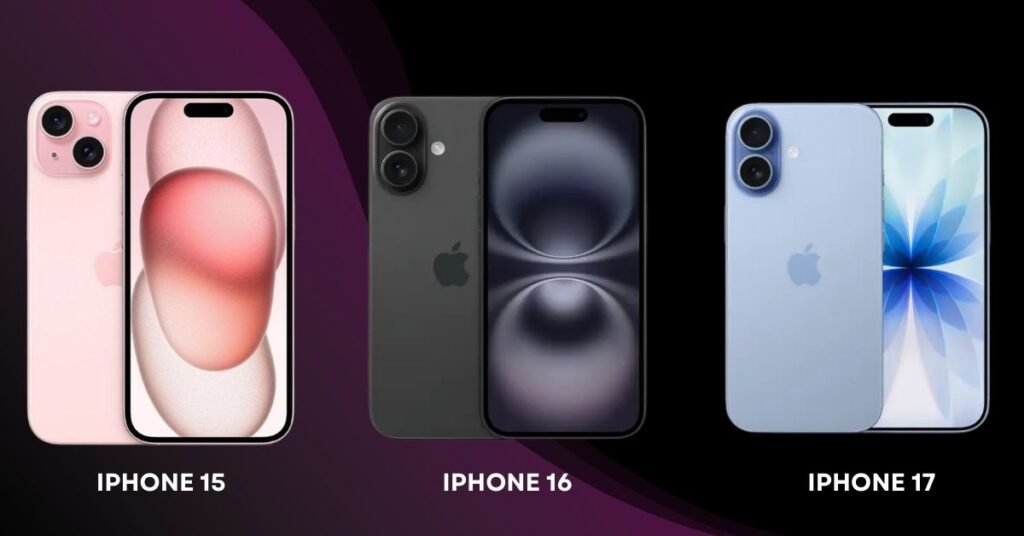
The comparison of iPhone 15, 16, and 17 has become a very popular discussion amongst users. Everyone seems to ask themselves this question: Which phone is going to give them the best bang for their buck? Apple continues to upgrade performance, camera performance, battery life, and add more artificial intelligence to its latest iPhones, which is helping them become the most advanced smartphones available.
The question that all users should be asking themselves is whether or not the newest model is worth the money when they can use their current model for daily usage. From gaming and multitasking to photography and long-term software support, each device offers something different. In this detailed comparison, you’ll discover which iPhone stands out in real-world use and which one is actually worth buying in 2026.
iPhone 15 vs iPhone 16 vs iPhone 17: What’s New in 2026 That Everyone Is Talking About?

The iPhone 15 marked Apple’s bold USB-C transition back in 2023. No more Lightning cables cluttering your nightstand. The Dynamic Island expansion across all models transformed that awkward notch into something genuinely useful. Standard models packed the A16 Bionic chip, while Pro versions flexed the A17 Pro’s muscle. The 48MP Main camera finally arrived, and Pro users got their first taste of the Action button—a physical shortcut that actually saved time.
Fast forward to the iPhone 16, and Apple standardized the A18 chip across the lineup with 8GB RAM minimum. The impact of the memory upgrade on Apple Intelligence has been greater than anticipated. The Camera Control button landed on every model, giving tactile control over shots. Enhanced thermal management meant your phone stopped feeling like a hand warmer during FaceTime calls. Visual Intelligence debuted, turning your camera into a smart assistant.
Pro Tip: The iPhone 16’s 8GB RAM baseline is the real game-changer for longevity—it’ll handle iOS updates smoothly through 2030.
Now the iPhone 17 arrives with whispers of an anti-reflective display coating that actually works in sunlight. The A19 chip brings dedicated AI processing cores. ProMotion technology might finally hit standard models. Satellite connectivity expands beyond just Emergency SOS via satellite into Messages via satellite and Roadside Assistance via satellite through Globalstar. The computational photography engine supposedly leaps generations ahead.
| Feature | iPhone 15 | iPhone 16 | iPhone 17 |
|---|---|---|---|
| Processor | A16/A17 Pro | A18/A18 Pro | A19/A19 Pro |
| Base RAM | 6GB/8GB | 8GB | 8GB/12GB |
| Action Button | Pro only | All models | All models |
| Camera Control | No | Yes | Yes (enhanced) |
| Apple Intelligence | Limited | Full support | Full support+ |
| Satellite Features | Emergency SOS | Emergency SOS | Full suite |
iPhone 15 vs. iPhone 16 vs iPhone 17: Full Design & Display Comparison

Hold an iPhone 15 and an iPhone 16 side by side, and the weight difference is negligible—until you’ve carried one in your pocket for 8 hours. Titanium on Pro models sheds grams while adding scratch resistance beyond standard aluminum. Ceramic Shield technology has evolved, but real-life drop tests show that the benefits of using Ceramic Shield technology are less than expected in relation to drop test results.
The Super Retina XDR display across all three models delivers stunning visuals, but pixel density tells only part of the story. Outdoor visibility matters more. The iPhone 17’s rumored anti-reflective coating could genuinely revolutionize sidewalk scrolling. ProMotion technology with its 120Hz adaptive refresh makes scrolling buttery smooth—but only Pro models currently enjoy this luxury. With the Always-on display feature, you can see the time and the information displayed in a widget without having to touch your phone; however, how it affects the battery will be determined by how you utilise the device.
Pro Tip: The Always-On display drains roughly 0.8% battery per hour when stationary—disable it if you’re squeezing every minute from your charge.
True Tone display adjusts white balance based on ambient lighting across all models. HDR display capability means Netflix content pops with proper contrast. The IP68 rating guarantees splash dust resistant durability—all three generations survive 30 minutes at 6 meters depth per IEC standard specifications.
Face ID performance improved subtly between generations. The 12MP TrueDepth camera handles authentication faster on newer models, working better in darkness and at wider angles.
iPhone 15 vs iPhone 16 vs iPhone 17: Camera Upgrades That Matter in Real Life
Photography separates casual users from believers. The iPhone 15 features a new 48 MP Fusion Camera that uses pixel binning to capture better photos in low light. The dual-camera system (main companion and ultra wide) can handle most photography needs very well. Photonic Engine processing delivered impressive indoor shots without grain.
The iPhone 16 refined everything. Its 48MP Main sensor, paired with improved sensor-shift OIS (optical image stabilization), eliminated blur during concert videos. The Ultra Wide camera gained better low-light capabilities. Optical zoom reached 2x without quality loss. Macro photography lets you capture intricate details within inches.
Night mode works automatically across all lenses now. Photographic Styles evolved from filters into genuine creative tools that remember your preferences. The Neural Engine processes images faster, so HDR shots don’t lag between pressing the shutter and seeing results.
Video recording is an important part of creating content today. All three of the new iPhones can record at 60 frames per second (fps), but how long each can maintain its performance while recording video will depend on thermal management. Therefore, an iPhone 16 and iPhone 17 will be able to maintain their performance longer than an iPhone 15 when filming extended videos due to better thermal management.
Pro Tip: Enable ProRAW for maximum editing flexibility—but each photo consumes 10x more storage than standard HEIF format.
The front-facing camera gets overlooked despite handling every video call. That 12MP TrueDepth camera improved portrait mode accuracy and low-light performance generation over generation.
iPhone 15 vs iPhone 16 vs iPhone 17: Performance & Speed Test Reality
Benchmark numbers impress tech forums. Real-world speed determines daily frustration levels. The A16 Bionic chip in base iPhone 15 models handles everything smoothly—until you’re editing 4K video or running demanding games simultaneously with a dozen background apps.
The A18 chip in the iPhone 16 brought efficiency cores that sip power while performance cores tackle heavy lifting. The Neural Engine allows Apple’s Intelligent features to run much faster, such as writing tools and notification summaries, and 8 GB of RAM means you don’t have to keep reloading Safari tabs all the time.
The iPhone 17 comes with an A19 chip optimized for AI, which should double its performance in AI processing. In addition, the A19 chip has dedicated cores specifically for ML (Machine Learning), which allows it to complete machine learning tasks without using up resources from the main processor. This is particularly helpful for using real-time translation and advanced photo editing.
RAM management differences surface during multitasking marathons. Open Instagram, switch to Messages, check email, jump to Safari, back to Instagram—and your feed refreshes on older 6GB RAM models. The 8GB minimum on newer devices maintains app states reliably.
Storage speed improved incrementally. Current mobile applications can get large fast; a new iOS operating system plus some common applications can take up at least 30GB of space. Photo libraries have also become very large, growing exponentially. Cloud integration helps, but Wi-Fi calling and cellular connection speeds determine how quickly files sync.
iPhone 15 vs iPhone 16 vs iPhone 17: Battery Life for Your Daily Grind

Official specs promise video playback hours that nobody actually experiences. Real battery testing involves mixed usage—scrolling social media, streaming music during commutes, video calls, navigation, and photography.
The iPhone 15 delivers solid endurance. Depending on average usage, standard models can last all day while using moderate amounts of power. The pro model’s much larger battery allows for extended use into the evening. The 15W MagSafe Wireless Charger is by far the fastest way to charge the phone back up; Qi Wireless Chargers and Qi2 wireless chargers also offer some flexibility and are compatible with several third-party wireless chargers.
Pro Tip: Fast charging produces a lot of heat, which reduces the health of the battery; therefore, using a 15W wall adapter on a regular basis allows you to get the most out of your battery capacity over time.
Power efficiency has been improved on the iPhone 16 due to the new A18 chip architecture; users have reported an increase of 10% to 15% in battery life compared to real-world testing. The implementation of optimized MagSafe helps to reduce heat during charging.MagSafe cases aligned magnets better, improving charging efficiency.
However, battery degradation occurs over time. In general, users can expect 80% capacity after about 500 full charge cycles, or an average of 18 months. iOS battery health reporting does give you some insight into your battery that you have, but replacement costs will be between $99 and $129 (depending on model) as of 2026.
iPhone 15 vs. iPhone 16 vs. iPhone 17: Apple Intelligence Changes Everything
Apple Intelligence represents Apple’s AI strategy—privacy-focused, on-device processing where possible. The catch? It demands 8GB RAM minimum. Because base iPhone 15 models cannot benefit from the full experience, they will be at a disadvantage.
Writing tools can help you improve your sentences and the way they sound in your writing, plus provide you with Quick View for different apps; this means you can see your most critical alerts at a glance, but all of the less important alerts will be grouped at the bottom of the list of visible alerts so that you can ignore them or get back to them later if you want to. And with the new Type to Siri feature included in iOS 9, Siri has become much more practical and usable, especially when you’re in public or during a meeting.
Visual Intelligence on the newly released iPhone 16 and iPhone 17 has completely changed how we can take pictures and what kind of imagery presentation we will get on the iPhone. For instance, if you aim your camera at a restaurant, it will show all the relevant information about that establishment (including hours of operation, menu items, etc.) without having to close any other app or have an extra app open that provides this info.
Pro Tip: Apple Intelligence respects privacy protections by processing most requests on-device—but complex queries use Private Cloud Compute with end-to-end encryption.
Photo and video tools gained intelligence. Clean Up removes photobombers convincingly. Memory creation automation curates highlights from vacations without manual curation. Search functionality understands natural language—”show me photos from last summer with dogs” actually works.
The Neural Engine handles these AI tasks efficiently. Older chips struggle with simultaneous requests. The A19 chip supposedly processes twice as many operations per second, making features instantaneous rather than laggy.
iPhone 15 vs iPhone 16 vs iPhone 17: Gaming & Multitasking Without Compromise
The graphics quality of mobile games has drastically improved as a result of the powerful graphics processing capabilities of the devices (Apple’s A9 chip), so both Genshin Impact and Honkai: Star Rail will push the thermal limits of mobile devices to their max for about 20-30 minutes before thermal throttling begins. Frame rates drop from 60fps to 40fps as the aluminum chassis heats up.
The iPhone 16 addressed thermal management aggressively. Titanium dissipates heat more effectively on Pro models. The A18 chip runs cooler under load. Players have stated that they are able to achieve at least 60 frames per second (fps) for 45+ minutes before they experience any kind of degradation in the gameplay.
The upscaling capabilities of MetalFX on the newer models allow for games to be rendered at lower resolution and then upscaled intelligently, which reduces the amount of processing required to maintain visual fidelity. Ray tracing support adds realistic lighting in compatible titles.
Multitasking separates casual users from power users. Picture-in-picture video while browsing Safari, while downloading files, while syncing photos—older models choke. The 8GB RAM baseline on iPhone 16 and iPhone 17 handles these scenarios effortlessly.
Controller support via Bluetooth works universally, but latency differences emerge during competitive gaming. Upgraded chips allow you to process inputs faster, decreasing milliseconds of delay; time is of the essence in shooter games.
iPhone 15 vs iPhone 16 vs iPhone 17: Price vs Value—The Real Verdict
Numbers tell stories. The iPhone 15 currently sells for $599-699 refurbished, $799 new for base models through carriers. The iPhone 16 retails at $899-999. The iPhone 17 launched at $999-1,199 depending on storage and model tier.
Choose iPhone 15 if:
- Decisions are based mostly on budget constraints
- Camera capabilities of the 2023 model will meet your needs
- You have a device being upgraded from an iPhone 11 or older
- You will have to upgrade again within 24 months
- Carrier subsidies make it almost free
Choose iPhone 16 if:
- You want great Apple technology without the high price.
- Apple Features Photography Control
- 8GB of ram will last 4-5 years
- Thermal improvements help gamers
- Best value for features & price
Choose iPhone 17 if:
- Cutting-edge technology = premium price
- Content creation at a professional level = use age
- 5 year warranty = Longevity
- Improved satellite connectivity. = more than just emergencies.
- Improvements to your display every day with ProMotion technology.
Pro Tip: Apple’s Trade-in programs provide customers the best return on their investment with an estimated trade value of $300-$400 for the iPhone 12 Pro towards an iPhone 17 purchase.
Additional costs of owning an iPhone include ($199-$269) for an AppleCare+ plan, ($40 to $80) for cases, and ($20-$40) for screen protectors. Resale value after two years drops 40-50% for standard models, 35-45% for Pro variants.
Complete Specifications Comparison
| Specification | iPhone 15 | iPhone 16 | iPhone 17 |
|---|---|---|---|
| Display | 6.1″ Super Retina XDR | 6.1″ Super Retina XDR | 6.1″ Super Retina XDR with anti-reflective coating |
| Chip | A16/A17 Pro | A18/A18 Pro | A19/A19 Pro |
| Camera System | Dual-camera (48MP + 12MP) | Dual-camera (48MP + 12MP enhanced) | Advanced dual-camera (48MP Fusion) |
| Video Recording | 4K 60fps | 4K 60fps with enhanced stabilization | 4K 60fps with ProRes |
| Battery | Up to 22 hours of video | Up to 24 hours of video | Up to 24 hours video |
| Charging | MagSafe (15W), Qi wireless | MagSafe (15W), Qi2 charging | MagSafe (15W), Qi2 charging optimized |
| Connectivity | 5G, Wi-Fi 6 | 5G, Wi-Fi 6E | 5G Advanced, Wi-Fi 7 |
| Satellite Features | Emergency SOS via satellite | Emergency SOS via satellite | Full satellite connectivity suite |
| Safety Features | Crash Detection | Crash Detection enhanced | Crash Detection + advanced sensors |
| Water Resistance | IP68 (6m for 30 min) | IP68 (6m for 30 min) | IP68 (6m for 30 min) |
| Dynamic Island | Yes | Yes | Yes (enhanced functionality) |
| Action Button | Pro models only | All models | All models |
| Camera Control | No | Yes | Yes (pressure-sensitive) |
| Starting Price | $799 | $899 | $999 |
Final Verdict: Your 2026 iPhone Decision Simplified
The iPhone 15 vs iPhone 16 vs iPhone 17 debate boils down to priorities. Budget shoppers win with the iPhone 15—it remains capable despite missing cutting-edge AI features. For most customers, the iPhone 16 is the best value due to the price, Apple intelligence, enhanced thermal performance, and camera control; this makes the iPhone 16 the most popular model purchased.
Individuals passionate about technology, including professionals and enthusiasts, will benefit from an iPhone 17. The new iPhone’s 19A chip, better satellite capabilities, and possible display updates all imply that your investment would be worth it if you’re someone who regularly uses those improved features.
READ ALSO: Why Xiaomi 17’s Snapdragon 8 Elite Gen 5 Is a Game-Changer for Android Flagships in 2026
Consider your current device’s age. Upgrading from iPhone 11 or older? Any of these three delivers massive improvements. iPhone 13 users might skip the iPhone 15 entirely. If you currently own an iPhone 14, there are very few compelling reasons for you to upgrade to the iPhone 17 before launch.
FAQs
Which one is better, iPhone 15, 16, or 17?
if you want a top-performing smartphone with the most recent upgrades, if you have a higher budget; then, an iPhone is going to be the perfect option. On the other hand, you can still get excellent value and utility out of previous versions, such as the 15 and 16 models.
Is the iPhone 17 better than the 16?
To make things simpler, the differences between the 16 and 17 models are minimal. So, for individuals who only use their phones occasionally or on an infrequent basis, there is no reason not to get a 16 because it’s reasonably priced.
Is there a big difference between the iPhone 15 and 17?
There is evident growth from the iPhone 15 to iPhone 17; their speed, improved camera systems, longer battery life, and addition of AI features are all more compelling than the iPhone 15. The improvements are particularly noticeable in how they perform in real-world situations, making the iPhone 17 a much faster and higher-quality device, but the iPhone 15 is still good enough for daily tasks.
Is an iPhone 16 much better than an iPhone 15?
There is a clear improvement from the iPhone 16 to the iPhone 15 when comparing sports performance, an upgraded camera system, features, etc. However, for basic daily usage, many customers would be very satisfied using an iPhone 15.
Should I change from iPhone 16 to 17?
If you want the best performance, camera upgrades, and the newest features, then yes — upgrading from iPhone 16 to iPhone 17 is worth it in 2026. But if your iPhone 16 still runs smoothly and meets your needs, you can comfortably stick with it for now.

Ansa is a highly experienced technical writer with deep knowledge of Artificial Intelligence, software technology, and emerging digital tools. She excels in breaking down complex concepts into clear, engaging, and actionable articles. Her work empowers readers to understand and implement the latest advancements in AI and technology.