
Artificial intelligence tools are no longer optional for businesses. They’re the backbone of how modern companies operate, compete, and grow in 2026. The businesses pulling ahead aren’t working harder — they’re using smarter AI to automate faster, create better, and scale without burning out their teams.
Knowledge workers waste roughly 40% of their workday on repetitive, low-value tasks. That’s nearly half your payroll going nowhere. The good news? The right artificial intelligence tools win that time back — starting today.
This guide covers the most powerful AI tools available right now, how they’re reshaping industries, and exactly what to look for before you invest a single dollar.
Pro Tip: Start with one AI tool that solves your biggest daily bottleneck first.
What Are the Most Powerful Artificial Intelligence Tools in 2026?

Artificial intelligence tools in 2026 fall into two camps. First, tools that generate content, code, images, and audio. Second, tools that act — autonomous AI agents completing multi-step tasks without hand-holding.
That second category is changing everything. Gartner projects that by the end of 2026, 40% of enterprise applications will include task-specific AI agents. That’s not a future prediction anymore. It’s already running inside companies right now.
The five core categories shaping today’s landscape are conversational AI and reasoning tools like ChatGPT o3, Claude, and Gemini models; AI orchestration platforms like Zapier and n8n; productivity and knowledge management tools like NotebookLM and Notion; creative tools covering content creation, video creation, and image generation; and AI search engines like Perplexity that deliver sourced, real-time answers.
Understanding which category solves your actual problem is the first step. Buying a tool before answering that question is exactly how businesses waste their budget.
Pro Tip: Match every AI tool to one specific problem before you buy it.
How Artificial Intelligence Tools in 2026 Are Transforming Businesses
Artificial intelligence tools in 2026 have crossed the line from experimental to essential. Businesses aren’t asking “should we use AI?” anymore. The big question now is: are we moving quickly enough?
Based on its research, McKinsey has found that companies that are implementing AI have realized an increase in their revenues from 3% – 15%. Additionally, sales teams realize 10%-20% return on investment (ROI) from using AI in their sales strategies. This is more than a theory; it has been proven that AI has measurable results that have affected businesses positively. Deloitte backs this up, reporting that 88% of agentic AI early adopters are already seeing positive ROI on at least one use case.
The transformation is hitting every department hard. Marketing teams use generative AI models and AI writing generators to produce campaign copy in minutes, not days. The operations team is automating all of their tedious, manual processes by creating automation workflows using either Zapier or n8n.
The human resources (HR) team is also automating a lot of the processes they use to screen resumes using machine learning tools that allow them to efficiently identify the best candidates faster than any other recruiter.
Finance/customer service departments (in addition to operations and HR) can fully automate their anomaly detection processes/compliance reporting functions using AI. The customer service department can use AI to manage 80% or more of its incoming inquiries without any real human involvement via chatbots that utilize large language models (LLMs).
The window to gain a real competitive edge with artificial intelligence tools is still open. But it won’t stay open forever.
READ ALSO: The Quantum Internet Race: How U.S. Labs Are Building the Next Secure Network
Top AI Tools in 2026 Every Business Should Use Today
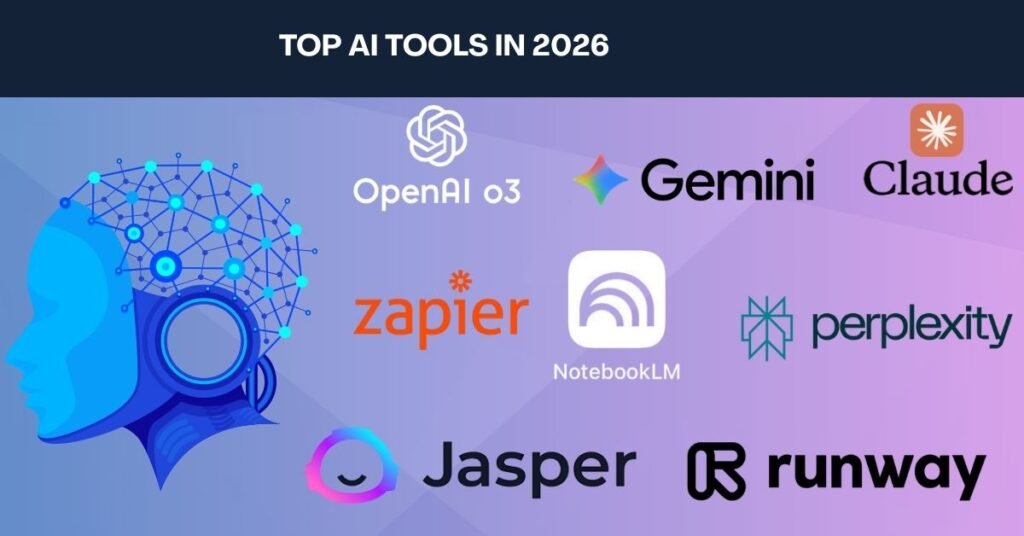
AI tools have the highest impact on the business when they are specifically designed to satisfy an organizational business requirement. The following is a summary of the top-performing corporate-wide, evidence-based AI Platforms with proven performance.
ChatGPT o3 leads the reasoning category. It uses chain-of-thought processing to think through problems before responding, which dramatically reduces errors in coding, math, and complex multi-step tasks. For teams doing heavy analytical work, it’s the most capable general-purpose tool on the market today.
Google Gemini integrates deeply across Google Cloud products and the full Google Workspace suite — Docs, Sheets, Gmail, and Drive. Its multimodal understanding handles text, images, code, and audio in one unified workflow. Through Google(AI) Studio, developers have immediate access to numerous Gemini models via the Gemini Developer API to expedite the development of new AI models without the requirement for extensive hardware resources.
Claude from Anthropic excels at nuanced long-form writing, document analysis, and safety-conscious enterprise AI tasks. It’s the go-to AI chatbot for businesses that need reliable, thoughtful output on sensitive or complex content.
Zapier is the AI productivity tool connecting the entire tech stack. Zapier Agents act as AI agent builders, executing multi-step actions across 8,000+ apps autonomously. Think of Zapier Central as the automation layer that makes every other tool in your stack smarter. Teams using it report saving 10+ hours per week on manual work alone.
NotebookLM from Google is built differently from other knowledge management tools. It works exclusively on your uploaded source material — PDFs, reports, meeting transcripts — and builds a personalized assistant grounded only in your own data. The Deep Dive audio overviews feature turns dense research into conversational audio summaries, making it one of the best AI research assistants available at any price point.
Perplexity sits at the top of the AI search engines category. Unlike traditional search, it combines a large language model with live web searches to deliver direct answers alongside real citations. It actively reduces hallucinations — a major problem with older AI tools — by grounding every answer in verifiable sources. Teams often use competitive research/industry analyses from the day prior for their work on a daily basis.
For creative purposes, Jasper & Anyword will help you scale production of marketing copy & content. Companies like Grammarly & Wordtune have established themselves in the grammar checking area, but also have tools for rewording your material and enhancing your text well beyond just spell checking.
Runway & Google’s Veo 3 are considered top players in video creation because they allow teams to use AI to create a professional-looking video without spending any money on production costs. Midjourney & Ideogram deliver amazing images based on textual inputs very quickly (within seconds).
In social media management, various companies such as FeedHive, Buffer, & Flick offer tools that automate the scheduling of posts and the repurposing of content across all social networks. For project management, clicking on any of ClickUp, Asana, or Hive integrates AI into the task management & workflow blocking detection process.

| Tool | Category | Best For | Starting Price |
|---|---|---|---|
| ChatGPT o3 | Conversational AI | Reasoning & coding | Free / $20/mo |
| Claude | AI Chatbots | Writing & analysis | Free / $20/mo |
| Google Gemini | Multimodal AI | Google Workspace users | Free / $19.99/mo |
| Perplexity | AI Search Engines | Research with citations | Free / $20/mo |
| Jasper | Content Creation | Marketing copy | $39/mo |
| Zapier | AI Orchestration | Workflow automation | Free / $19.99/mo |
| NotebookLM | Knowledge Management | Source-grounded research | Free |
| Runway | Video Creation | AI video editing | $12/mo |
| Grammarly | Grammar Checkers | Text enhancement | Free / $12/mo |
| Midjourney | Image Generation | Text-to-image art | $10/mo |
Pro Tip: In addition to using Zapier, integrating it with ChatGPT provides you with the ability to fully automate your workflow for creating new content.
Artificial Intelligence Tools in 2026 Driving Innovation Across Industries
Artificial Intelligence tools will revolutionise industries across the board, not just technology. However, many businesses underestimate how much AI will change their industry.
Amongst all industries, Healthcare leads the way in AI cost savings. By 2026, healthcare providers are expected to achieve up to USD$150 billion in annual savings due to the implementation of AI tools like early warning systems to monitor patients and flag early warning signs.
The use of optical character recognition (OCR), face recognition, and landmark detection on the Google Cloud’s Cloud Vision AI engine for medical images will further support this. Recognition capabilities are being applied to diagnostic imaging workflows at scale.
Finance and insurance saw a full AI adoption surge from just 8% in 2024 to 34% in 2025. Automated underwriting has become the norm among the largest financial institutions through automated fraud detection in real time and AI-based modeling of risk.
Through the use of AI recommendation engines, retailers/e-commerce can personalize every customer experience. Natural Language Processing API facilitates sentiment analysis, entity recognition, and content categorization for brands to identify what customers actually feel, at an unmanageable scale, by human teams.
READ ALSO: British AI Tool Could Revolutionize Manufacturing: Here’s What It Brings to Industry 4.0
Companies in manufacturing use AI agents so that cost vs time to market can be balanced in real time, resulting in substantial reductions to delays in the production process when AI is used for scheduling/supply chain decisions autonomously.
Media and advertising use several Video Intelligence tools, including shot detection, label detection, and explicit content filters, to manage their large archives of video footage. The Speech-to-Text and Text-to-Speech APIs are used to transcribe audio from meetings, podcasts, and training material with WaveNet voices to produce natural sounds that no longer sound robotic.
The Translation API provides global business solutions by utilizing Neural Machine Translation to help break language barriers as well as provide real-time translations of hundreds of different languages through the use of many different language pairs. This allows companies to enter new markets without any delay, waiting for human translators.
It is expected that Intelligence Driven Processes will account for 25% of all business operations by 2026, a total increase of 8X from 2019.
Key Features to Look for in AI Tools in 2026
| Feature | Why It Matters | What to Check |
|---|---|---|
| Agentic Capability | Can it act, or just generate text? | Multi-step task execution |
| Integration Depth | Does it fit your existing tech stack? | Native app connections |
| Reasoning Quality | How well does it handle complex problems? | Hallucination rate |
| Data Privacy & Compliance | Critical for healthcare, finance, and GDPR | SOC 2, HIPAA, GDPR badges |
| Governance & Oversight | Easy human control over autonomous actions | Audit logs, approval flows |
| Scalable Pricing | Does cost grow reasonably with usage? | Per-seat vs. usage-based |
| Measurable ROI | Can you track value within 30 days? | Built-in analytics & reporting |
| Support & Documentation | Will you get help when things break? | Live support, active community |
Future Trends: How Artificial Intelligence Tools Will Shape 2026 and Beyond
Artificial intelligence tools are evolving faster than most businesses can track. Understanding what’s coming next helps you invest in the right platforms today rather than scrambling to catch up in 12 months.
The biggest structural shift is in multi-agent systems. Single-purpose bots are already becoming obsolete. In 2026, teams of AI agents collaborate — each with specialized roles, passing work between them like a well-run human team. IBM experts confirm we’ve fully moved into this era, where orchestration beats raw model power as the real competitive differentiator.
The generative AI category is maturing fast. Gen AI use cases have expanded well beyond basic content generation into full Agent Builder workflows, technical blueprints, and autonomous decision-making pipelines. Google Cloud’s Vertex AI continues expanding its available regions and free tier options, lowering the barrier for businesses of every size to build on enterprise-grade cloud computing infrastructure.
Here’s what shapes the next 24 months for every business using AI:
- Physical AI adoption is set to jump from 50% limited use today to 80% within two years, led by manufacturing, logistics, and defense sectors
- AI governance becomes non-negotiable — organizations deploying agents faster than they can secure them face serious operational and legal exposure
- AI-first operating models emerge as PwC predicts centralized AI studios linking company-wide strategy directly to AI execution
- Quantum computing begins intersecting with AI workloads, with IBM targeting 2026 as the year quantum outpaces classical computing for specific AI tasks
The businesses that build governance and oversight into their AI stack now — not later — will hold the most durable competitive advantage going forward.
Conclusion
Artificial intelligence tools in 2026 are the foundation every competitive business is building on. The ROI is proven. The tools are mature. The only remaining question is whether your business moves fast enough to use them well before your competitors do.
Start small. Pick one tool. Solve one real problem. Measure the result within 30 days. Then scale what works. That’s the playbook smart businesses are running right now — not chasing every shiny new feature, but executing consistently with the right artificial intelligence tools in the right workflows.
READ ALSO: Google Best AI Tools Set to Collaborate for Greater Impact
FAQs
Are artificial intelligence tools expensive for small businesses?
No. Many top AI tools like NotebookLM, Perplexity, and ChatGPT offer free plans.
Can AI tools replace human employees in 2026?
No. They automate repetitive tasks but still need human oversight and decision-making.
Do AI tools work without technical skills?
Yes. Most modern AI tools are no-code and built for everyday business users.
Are AI tools safe for storing business data?
Yes. Leading platforms like Google Cloud and Claude meet strict GDPR and SOC 2 compliance standards.
Can small businesses see real ROI from AI tools?
Yes. Deloitte reports 88% of early adopters saw positive ROI on at least one use case within months.

Ansa is a highly experienced technical writer with deep knowledge of Artificial Intelligence, software technology, and emerging digital tools. She excels in breaking down complex concepts into clear, engaging, and actionable articles. Her work empowers readers to understand and implement the latest advancements in AI and technology.